Iron-Rich Foods for BLW and Purées: 12 Best First Foods
Babies need 11 mg of iron a day from 7 to 12 months (NIH). The 12 best iron-rich foods for BLW and purées, with iron per serving and how to serve each one.
By the Avo Parenting teamPublished November 24, 20264 min read
In short
- Babies are born with iron stores that run low at about 4 to 6 months; from 7 to 12 months they need 11 mg of iron a day, more than an adult man's 8 mg (NIH).
- Per serving, the richest foods a baby can eat are lentils, cooked spinach and firm tofu (3 mg), then beef, sardines, chickpeas and kidney beans (2 mg), in the NIH food table.
- For baby-led weaning (BLW), serve them as food a baby can hold: tofu strips, slow-cooked beef strips, soft meatballs, lentil patties, omelette strips. For purées, blend the same foods smooth at 6 months and thicker from 8 months.
- Iron from meat and fish (haem iron) is absorbed far better than iron from plants, so serve lentils, beans and greens with a vitamin C food such as tomato, pepper, broccoli or strawberries.
- The AAP recommends 1 mg/kg of iron a day from 4 months for breastfed babies until iron-rich foods are part of their diet; cow's milk should not be a main drink before 12 months (NHS).
Iron is the nutrient to plan for when your baby starts solids, whether you go with baby-led weaning (BLW), purées or a mix of both. Babies are born with iron stores from pregnancy, but by about 4 to 6 months those stores run low, and breast milk carries only a little iron (AAP). Between 7 and 12 months a baby needs 11 mg of iron a day, more than the 8 mg an adult man needs (NIH). The easy rule: an iron-rich food at every meal, as a finger food or on the spoon.
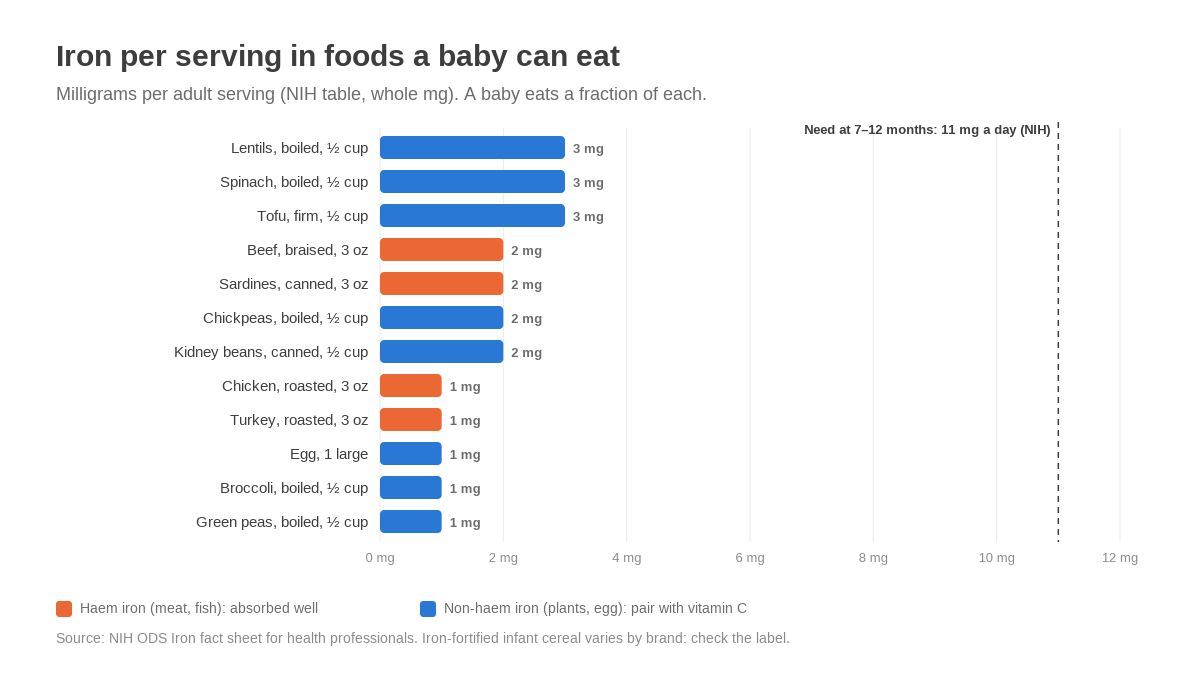
Iron per adult serving from the NIH food table. Your baby eats a fraction of each, which is why iron belongs in more than one meal a day.
The 12 best iron-rich foods for BLW and purées
| Food | Iron per serving (NIH) | BLW finger food from 6 months | Purée or spoon-fed |
|---|---|---|---|
| Lentils | 3 mg per ½ cup, boiled | Soft lentil patties | Red lentils simmered until they fall apart, blended |
| Spinach | 3 mg per ½ cup, boiled | Chopped into omelette strips or soft egg muffins | Wilted and blended into lentils or potato |
| Tofu, firm | 3 mg per ½ cup | Finger-length strips, baked or lightly pan-fried | Mashed or blended with fruit |
| Beef | 2 mg per 3 oz, braised | Large slow-cooked strips to suck on, or soft meatballs | Minced, slow-cooked and blended with veg |
| Sardines | 2 mg per 3 oz, canned | Mashed onto toast fingers | Mashed with potato or avocado |
| Chickpeas | 2 mg per ½ cup, boiled | Hummus with no added salt on toast fingers; never whole | Blended smooth with a little water |
| Kidney beans | 2 mg per ½ cup, canned | Squashed flat, or mashed into patties; never whole | Rinsed and blended with sweet potato |
| Chicken | 1 mg per 3 oz, roasted | Shredded thigh in soft patties | Dark meat blended with its cooking water |
| Turkey | 1 mg per 3 oz, roasted | Soft meatballs or finger-shaped patties | Minced, cooked and blended with veg |
| Egg | 1 mg per large egg | Thin omelette strips, cooked through | Hard-boiled yolk mashed with milk; a common allergen |
| Broccoli | 1 mg per ½ cup, boiled | Big soft-steamed florets with a stalk to hold | Steamed and blended |
| Green peas | 1 mg per ½ cup, boiled | Squashed flat, or mashed into patties | Blended and sieved for a smooth start |
Rinse canned beans and choose sardines canned in water with no added salt. Iron-fortified infant cereal belongs on the list too: mix it with your baby's usual milk for the spoon, or bake it into oat fingers or pancakes for BLW. The amount of iron varies by brand, so check the label.
An easy first iron purée: red lentils simmered in water for 15 to 20 minutes, then blended with steamed sweet potato, carrot, spinach or stewed apple. Serve it smooth at 6 months and mashed with soft lumps from 8 months. No salt or stock needed.
How to get more iron from every meal
- Pair plant iron with vitamin C. Iron from lentils, beans, tofu and greens is absorbed less well than iron from meat and fish (NIH). A vitamin C food in the same meal helps: lentils with soft tomato, beans with roasted bell pepper, cereal with strawberries, tofu with broccoli.
- Mix a little meat or fish into plant foods. Beef and lentil meatballs, or chicken blended with beans, help your baby absorb the plant iron alongside the meat.
- Keep cow's milk for cooking until 12 months. The NHS says cow's milk should not be a main drink before 1 year because it does not contain enough iron. It is fine in cooking, such as in eggs or pancakes, from about 6 months.
- Ask about a supplement if you breastfeed. The AAP recommends 1 mg/kg of iron a day from 4 months for breastfed babies until iron-rich foods are part of their diet, and screening every baby for iron deficiency at 12 months.
Every food above has its own page in the Avo app and on this site, with the safe size and shape to serve it at 6, 9 and 12 months. For the why behind iron, read our guide to iron-rich first foods.
Frequently asked questions
What are the best iron-rich foods for BLW?
Per serving in the NIH food table, the richest foods a baby can eat are lentils, cooked spinach and firm tofu (3 mg per half cup), then beef, sardines, chickpeas and kidney beans (about 2 mg a serving), and chicken, turkey, egg, broccoli and green peas (about 1 mg). For baby-led weaning the best of these are the ones a baby can hold: tofu strips, slow-cooked beef strips, soft meatballs, lentil patties and thin omelette strips.
What are the best iron-rich purées for babies?
Red lentils, beef, chicken, sardines and iron-fortified infant cereal all blend well. Red lentils are the easiest: simmer them in water for 15 to 20 minutes until they fall apart, then blend with sweet potato, carrot, spinach or stewed apple. Meat purées blend more smoothly with a little of your baby's usual milk or cooking water. Serve them smooth at 6 months and mashed with soft lumps from about 8 months.
How much iron does a baby need a day?
From birth to 6 months a baby needs only about 0.27 mg a day, covered by the iron stores built up in pregnancy plus breast milk or formula. From 7 to 12 months the NIH recommends 11 mg a day, which is why iron-rich foods matter from the first weeks of solids. From 1 to 3 years the figure drops to 7 mg a day.
Do baby-led weaning babies get enough iron?
They can, if iron-rich foods are offered at most meals. Early on, babies who feed themselves swallow small amounts, so lean on foods that pack iron into each bite: soft meat, sardines, lentils, beans and iron-fortified cereal, which you can bake into oat fingers or serve on a preloaded spoon. Offering an iron-rich food at two meals a day from about 7 months covers more of the gap.
Do breastfed babies need an iron supplement?
The AAP recommends that babies who are partly or completely breastfed get 1 mg/kg of oral iron a day from 4 months until iron-containing foods, including iron-fortified cereals, are part of their diet. Formula is already iron-fortified. Babies born early, small or after a complicated pregnancy may need iron sooner, so ask your paediatrician before starting a supplement.
Sources
The guidance in this article comes from these bodies. The badge shows which region's rules each one sets.
- USNIH Office of Dietary Supplements — Iron: Fact Sheet for Health Professionals
- USAAP HealthyChildren.org — Where We Stand: Vitamin D & Iron Supplements for Babies
- USAAP HealthyChildren.org — Starting Solid Foods
- UKNHS Best Start in Life — What to feed your baby from around 6 months
- UKNHS — Drinks and cups for babies and young children
- WHOWHO — Infant and young child feeding (fact sheet)