Baby Feeding Chart by Month: Milk, Solids and Textures From Birth to 12 Months
How much milk and food a baby needs at every month from birth to 1 year, in one chart, with the AAP, CDC, NHS, WHO and ESPGHAN figures and where they differ.
By the Avo Parenting teamPublished October 20, 202611 min read
In short
- Birth to 6 months is milk only: newborns feed 8–12 times a day, and by 6 months a formula-fed baby takes about 180–240 ml (6–8 oz) at each of 4–5 feeds (AAP).
- Solids start at around 6 months everywhere; the CDC says not before 4 months and ESPGHAN says not before 17 weeks and not after 26 weeks.
- Meals grow from once a day at 6 months (NHS) to 2–3 a day at 6–8 months (WHO) and 3 a day by 10 months (NHS), with milk feeds in between.
- Textures move from smooth or soft at 6 months to mashed and lumpy with finger foods at 7–9 months, then bigger soft chunks at 10–12 months (NHS, CDC).
- Formula drops to around 600 ml a day at 7–9 months and around 400 ml at 10–12 months (NHS); cow's milk is not a drink until 12 months (CDC, NHS, ESPGHAN).
For the first six months a baby's diet is milk and nothing else. From around six months solids join in, one meal a day at first, and over the second half of the year meals climb to three while milk feeds shrink to three or four.
That arc is the same in the American Academy of Pediatrics (AAP), the US Centers for Disease Control and Prevention (CDC), the UK's NHS, the World Health Organization (WHO) and the European paediatric society ESPGHAN.
What differs is the detail, and the detail is what you want when a baby is crying at 3 a.m. and you are wondering whether 150 ml was enough. This chart pulls every number those bodies publish into one table, then walks through each stage. Where a cell says "not specified," no authority gives a figure, and that is worth knowing too.
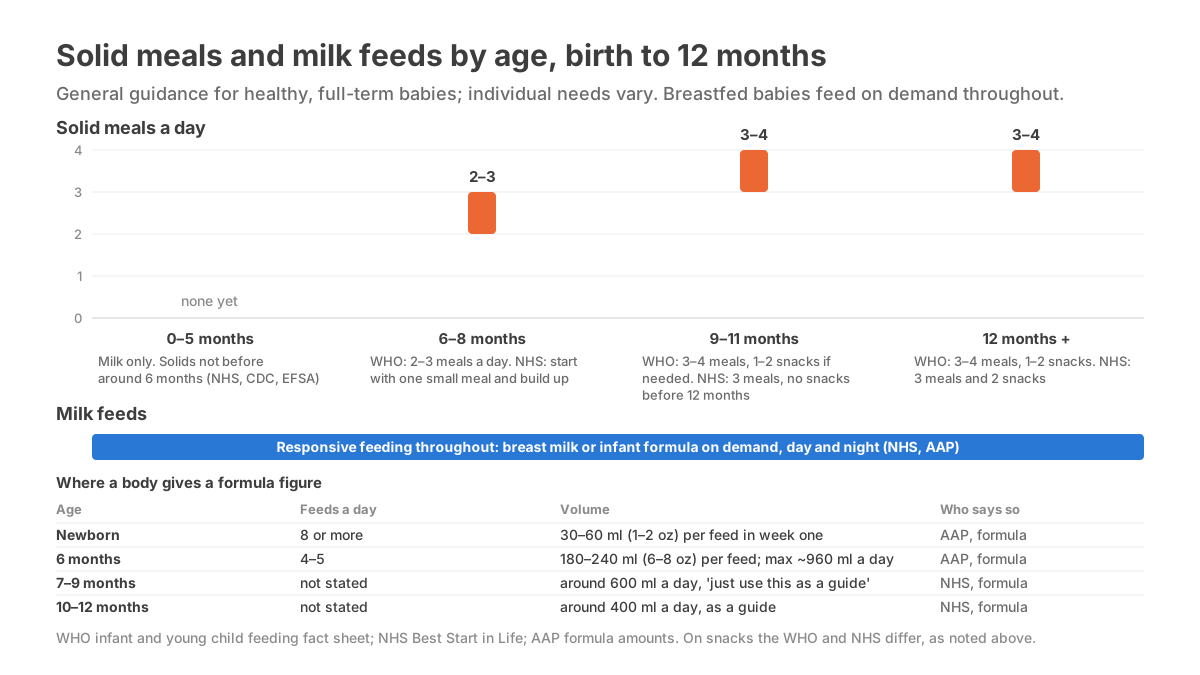
Solid meals by WHO age band, milk as responsive feeding, and the formula figures each body actually gives. General guidance for healthy, full-term babies; individual needs vary.
The feeding chart, birth to 12 months
Milk amounts are for formula-fed babies, because that is the only kind anyone measures. Breastfed babies feed on demand throughout; the AAP notes their intake "tops out at roughly 4.5 oz at a year of age" per feed.
| Age | Milk feeds (AAP, US) | Milk feeds (NHS, UK) | Solid meals | Textures | Who says what |
|---|---|---|---|---|---|
| 0–1 month | 8+ feeds a day; 30–60 ml (1–2 oz) per feed in week one, rising to 90–120 ml (3–4 oz) by the end of the month | "At least 8 to 12 times, or more, every 24 hours" in the first weeks; responsive feeding, no volumes | None | — | AAP, NHS |
| 1–3 months | Every 3–4 hours; at least 90–120 ml (3–4 oz) per feed | Responsive feeding; judge by weight gain and about 6 wet nappies a day | None | — | AAP, NHS |
| 4–5 months | Not specified; the 75 ml per 453 g (2½ oz per lb) rule applies, max ~960 ml (32 oz) a day | On demand | None for most babies; readiness signs are what matter | — | AAP, CDC ("not before 4 months"), ESPGHAN (not before 17 weeks) |
| 6 months | 180–240 ml (6–8 oz) × 4–5 feeds | On demand, milk after solids | 1 meal a day to start, 1–2 tablespoons; building to 2–3 meals | Smooth or soft mashed; soft finger foods | NHS (once a day), CDC (1–2 tbsp), WHO (2–3 meals at 6–8 months) |
| 7–9 months | Not specified | Around 600 ml a day as a guide; breastfeeds adjust to food | Moving towards 3 meals | Mashed, lumpier, plus finger foods | NHS, WHO |
| 10–12 months | Not specified | Around 400 ml a day; breastfed babies about 3 feeds | 3 meals a day; no snacks needed | Bigger soft chunks; wider variety of finger foods | NHS, WHO (3–4 meals from 9 months) |
| 12 months+ | Whole cow's milk can become the drink | Whole cow's milk; 3 meals and 2 snacks | 3 meals + 2 snacks | Family foods, cut safely | NHS, CDC, ESPGHAN |
The NHS is the only body that publishes month-band milk volumes after solids start, and it adds "just use this as a guide" to each one. The AAP gives the richest early figures and then stops at 6 months, because from there appetite for solids decides.
What does a newborn eat in the first month?
Milk, often. The AAP says breastfed newborns "usually nurse about every 2 hours," or 10 to 12 sessions in 24 hours, while for bottle-fed newborns "8 times is generally recommended as the minimum every 24 hours."
Amounts are small: "no more than about 1 to 2 ounces (30 to 60 ml) per feed" in the first week, then "gradually eat more until they take 3 to 4 ounces (90 to 120 ml) per feed" by the end of the month.
The NHS does not publish volumes for this stage at all. Its first-days guidance is "feed your baby as often as they want and for as long as they want. This is called responsive feeding," with "at least 8 to 12 times, or more, every 24 hours during the first few weeks" as "a very rough guide."
For bottle-fed babies it says the same in other words: "feed your baby when they show signs that they want it," and judge whether they are getting enough by weight gain and "around 6 wet nappies a day from a few days after the birth," not by millilitres.
How much milk does a baby drink from 1 to 5 months?
Formula-fed babies settle into "a fairly predictable schedule of feedings about every 3 to 4 hours" from the end of the first month, at "at least 3 to 4 ounces (120 mL) per feeding," according to the AAP.
Its weight rule, "about 2½ ounces (75 mL) of infant formula a day for every pound (453 g) of body weight," is the only published way to estimate a daily total between 2 and 5 months, always under the "no more than an average of about 32 ounces (960 mL)" ceiling.
Nothing solid happens in this window for most babies. The CDC says plainly that "introducing foods before 4 months is not recommended," and ESPGHAN's floor is "not before 4 months (17 weeks)." The European Food Safety Authority (EFSA) adds that "the majority of infants need complementary foods from around 6 months of age," even though the motor skills for purées can appear "between 3 and 4 months."
Being able to swallow a purée is not the same as needing one.
What changes at 6 months?
Solids begin, as an addition rather than a replacement. The CDC: "Breast milk and/or infant formula continues to be the main source of nutrition for your child from 6 to 12 months."
- Milk: the AAP's 180–240 ml (6–8 oz) at each of 4 or 5 feeds. The NHS keeps breastfeeding on demand and says to offer the milk feed after solids.
- Meals: "To start with, your baby only needs a small amount of solid food, once a day" (NHS). The WHO's range for 6 to 8 months is "2–3 meals per day."
- Amount per meal: "Give 1 or 2 tablespoons of food" (CDC); "a few pieces, or teaspoons of food" (NHS).
- Texture: the CDC starts with "mashed, pureed, or strained foods that are very smooth," while the NHS offers soft finger foods from the first day and says there is "no right or wrong way." ESPGHAN asks for "a variety of flavours and textures including bitter tasting green vegetables."
- Iron: ESPGHAN says "all infants should receive iron-rich complementary foods including meat products and/or iron-fortified foods," and the AAP asks for iron and zinc foods from the start.
Our 6 month old feeding schedule lays this stage out as two sample days, and the foods suitable at 6 months page lists what to offer.
What does a 7 to 9 month old eat?
This is the stage where the pattern flips from "milk plus a taste" to "meals plus milk."
- Meals: the NHS says babies "will gradually move towards eating 3 meals a day (breakfast, lunch and tea)." The WHO's 2–3 meals a day applies through 8 months; from 9 months its band changes to 3–4 meals, which is the NHS's "towards 3" seen from the other side.
- Milk: "Formula-fed babies may need around 600ml of milk a day, but just use this as a guide" (NHS). Breastfed babies "will adapt their feeds according to how much food they're having."
- Texture: "Offer more mashed, lumpier foods as well as a variety of finger foods" (NHS). The CDC describes the same shift to "thicker, lumpier foods" as eating skills develop. The NHS's rule for finger food is that "pieces about the size of your own finger work well."
- Drinks: sips of water from an open or free-flow cup at mealtimes; no juice (AAP: none under 12 months) and no snacks (NHS).
The common worry here is gagging on lumps. Gagging is a normal reflex that pushes food forward; choking is silent. Our gagging vs choking guide explains the difference, and the texture progression guide shows how to move from smooth to lumpy without rushing. The foods suitable at 9 months page lists what most babies can manage by now.
What does a 10 to 12 month old eat?
By now a baby "should now be used to having 3 meals a day – breakfast, lunch and tea – in addition to their milk feeds," in the NHS's words, and the WHO moves to "3–4 meals per day for infants 9–23 months."
- Milk: "If your baby has first infant formula, they may need around 400ml per day, but just use this as a guide" (NHS). A breastfed baby "may be down to about 3 milk feeds a day."
- Texture: "bigger chunks of soft food and a wider variety of finger foods"; babies "should be finding it easier to pick up small pieces of food and feed themselves" (NHS). This is the pincer-grasp stage; our pincer grasp guide covers it.
- Cow's milk: still not a drink. The CDC says it "is not recommended until your child is older than 12 months," the NHS says the same, and ESPGHAN's position is that "whole cows' milk should not be used as the main drink before 12 months of age." Cooking with it is fine from 6 months.
- Snacks: none needed under 12 months (NHS); from the first birthday, 3 meals and 2 snacks.
See the foods suitable at 12 months list and our guide to what changes at 12 months for the handover to toddler eating.
Where US, UK and European guidance differs
| Question | US (AAP, CDC) | UK (NHS) | Europe / international (ESPGHAN, EFSA, WHO) |
|---|---|---|---|
| Formula volumes | Per feed and per day, to 6 months; weight rule of 75 ml per 453 g | Only from 7 months, as rounded daily guides (600 ml, then 400 ml) | None; feed to appetite |
| Earliest start for solids | 4 months (CDC) | "Around 6 months" | 17 weeks (ESPGHAN); EFSA finds no harm or benefit before 6 months except for babies at risk of low iron |
| Gap between new foods | 3 to 5 days (AAP, CDC) | None stated; one new allergen at a time | None stated |
| First textures | Very smooth purées first, lumpier later (CDC) | Smooth or soft finger foods from day one; baby-led weaning is an option | ESPGHAN asks for varied textures, including bitter greens; EFSA notes finger-food skills most commonly at 5–7 months |
| Meals a day at 6–8 months | Not counted separately; 5–6 eating occasions including milk (CDC) | 1 a day to start, then towards 3 | 2–3 a day (WHO) |
| Snacks under 12 months | Within the 5–6 daily occasions | Not needed | 1–2 "as required" (WHO) |
| Juice under 12 months | None (AAP, CDC) | Avoid sweet drinks; water or milk only | ESPGHAN: fruit juices "should be avoided" |
Two of these matter in practice. The 3-to-5-day gap is American only; if you follow it from 6 months you will have tried roughly 45 foods by the first birthday, which is why the 100 first foods list is a year-long project in the US and a six-month one elsewhere.
And the texture question has moved: the CDC still describes starting smooth, while the NHS and ESPGHAN emphasise variety and finger foods early. Our purées vs baby-led weaning guide sets out both routes.
Keeping a record across these months is easier than remembering it. Avo Starting Solids logs every food, texture, allergen and reaction by date, so when the health visitor or paediatrician asks what your baby has tried, the answer is a list rather than a guess.
When should I ask a doctor about my baby's feeding?
Every body frames the chart as a guide and the baby as the authority. Call your paediatrician, GP or health visitor if your baby:
- is not following their growth curve, or has fewer wet nappies than usual
- consistently refuses milk for a day or more, or refuses all solids past 7 to 8 months
- gags and coughs on every texture at 9 months or later
- shows a rash, swelling, vomiting or diarrhoea after a food (and call emergency services for breathing difficulty or floppiness)
- was premature; the NHS says timing for solids should be individual advice from a health visitor or GP
For everything else, the AAP's line holds: "each child's readiness for solid foods depends on their own rate of development," and so does their pace through the rest of the chart.
Frequently asked questions
How many times a day should a newborn feed?
Breastfed newborns usually nurse about every 2 hours, which the AAP puts at 10 to 12 sessions in 24 hours; for bottle-fed newborns it gives 8 feeds as the usual minimum. Amounts are tiny at first: the AAP says no more than about 30 to 60 ml (1 to 2 oz) per formula feed in the first week.
How much formula should a baby drink per day by weight?
The AAP's rule of thumb is about 75 ml (2½ oz) of formula a day for every 453 g (1 lb) of body weight, up to an average of no more than about 960 ml (32 oz) in 24 hours. A 7 kg (15 lb) baby would land around 1,100 ml by the formula but should still stop at the cap and at their own fullness cues.
When do babies drop to 3 milk feeds a day?
Around 10 to 12 months, once three solid meals are established. The NHS says a breastfed baby at that stage may be down to about 3 milk feeds a day, and a formula-fed baby may need around 400 ml a day. Milk feeds shrink because meals grow, not on a fixed date.
What textures should a 9 month old be eating?
Mashed and lumpy foods plus a variety of finger foods, according to the NHS's 7 to 9 month guidance. The CDC describes the same progression from very smooth purées to thicker, lumpier foods as the baby's eating skills develop. By 10 to 12 months the NHS moves to bigger chunks of soft food.
Do babies need snacks before 12 months?
The NHS says no: babies under 12 months do not need snacks, and if they seem hungry between meals you should offer extra milk instead. From 12 months the NHS pattern is 3 meals plus 2 snacks. The WHO allows 1 to 2 snacks from 6 months only if required.
Sources
The guidance in this article comes from these bodies. The badge shows which region's rules each one sets.
- USAAP HealthyChildren.org — How Often and How Much Should Your Baby Eat?
- USAAP HealthyChildren.org — Amount and Schedule of Formula Feedings
- USAAP HealthyChildren.org — Where We Stand: Fruit Juice
- USCDC — When, What, and How to Introduce Solid Foods
- USCDC — How Much and How Often to Feed
- UKNHS — Breastfeeding: the first few days
- UKNHS — Formula milk: common questions
- UKNHS — Your baby's first solid foods
- UKNHS Best Start in Life — What to feed your baby from around 6 months
- UKNHS Best Start in Life — What to feed your baby, 7 to 9 months
- UKNHS Best Start in Life — What to feed your baby, 10 to 12 months
- EUESPGHAN Committee on Nutrition — Complementary Feeding position paper (2017)
- EUEFSA — Appropriate age range for introduction of complementary feeding (2019)
- WHOWHO — Infant and young child feeding fact sheet