Foods to Avoid for Babies Under 1: The Full List, and Where US, UK and EU Advice Differs
Honey, salt, sugar, whole nuts, cow's milk as a drink, juice, rice drinks, raw egg and high-mercury fish: every food to avoid before 12 months, and who says so.
By the Avo Parenting teamPublished October 20, 20269 min read
In short
- No honey before 12 months, anywhere: the CDC, NHS and France's ANSES all warn of infant botulism from Clostridium botulinum spores.
- Cow's milk is not a drink before 12 months (CDC, NHS, ESPGHAN), but it can go into cooking from 6 months; no juice before 12 months (AAP, CDC).
- Keep salt under 1 g a day (NHS) and add no sugar: the CDC says children under 24 months have 'no room in their diet for added sugars'.
- Whole nuts, uncut grapes, hard raw vegetables, hot dogs and popcorn are choking hazards (CDC); the NHS keeps whole nuts off the menu until age 5.
- The egg rule differs: the NHS allows raw or runny British Lion eggs, while US guidance says cook eggs until firm for anyone at higher risk, which includes children under 5.
Most foods are fine for a baby from around 6 months. A short list is not, and the reasons fall into four groups: a bug the baby cannot fight yet (honey, unpasteurised dairy, raw egg in some countries), a nutrient their kidneys or gut cannot handle (salt, cow's milk as a drink), a shape they cannot swallow safely (whole nuts, whole grapes), and a contaminant that builds up (mercury, arsenic).
The lists from the US Centers for Disease Control and Prevention (CDC), the American Academy of Pediatrics (AAP), the UK's NHS and Europe's ESPGHAN and ANSES overlap almost entirely. Where they differ, mostly on eggs, nuts and how strictly to read the mercury list, we say so and name the body.
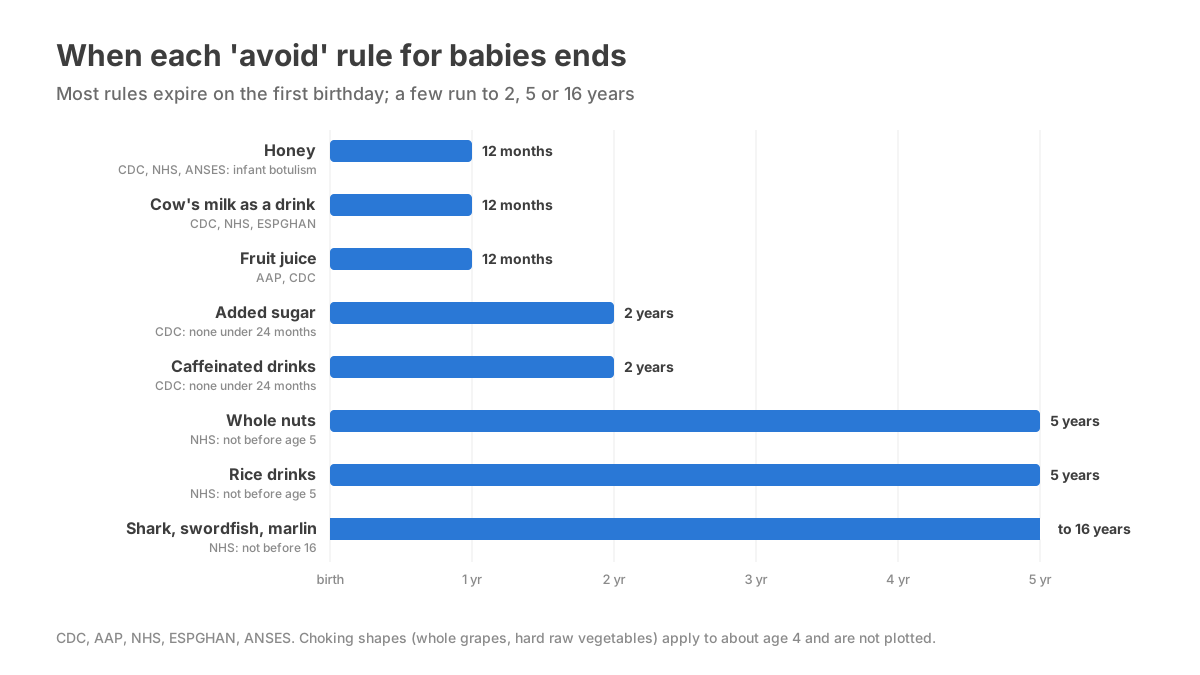
When each 'avoid' rule ends, by the body that sets it. Choking shapes apply to about age 4.
Which foods are unsafe for babies under 12 months?
These are the hard "no" items, with the authority behind each.
| Food | Why | US (CDC, AAP, FDA) | UK (NHS) | Europe (ESPGHAN, ANSES) |
|---|---|---|---|---|
| Honey | Infant botulism | "May cause a severe food poisoning called botulism" before 12 months (CDC) | Not until "over 1 year old" | ANSES: "should not be fed to infants under one year of age" |
| Cow's milk as a drink | Too much protein and minerals for infant kidneys; iron-poor | "Not recommended until your child is older than 12 months" (CDC) | "Not as a drink until your baby is 12 months"; fine in cooking from 6 months | "Should not be used as the main drink before 12 months" (ESPGHAN) |
| Fruit juice | No benefit, tooth decay, taste for sweet drinks | AAP: none under 12 months; CDC: "should not drink any fruit or vegetable juice" | Avoid sweet drinks; water or milk only | ESPGHAN: "fruit juices or sugar-sweetened beverages should be avoided" |
| Unpasteurised milk, cheese, juice | Listeria, E. coli, salmonella | Avoid; "may put your child at risk for harmful bacteria" (CDC) | Avoid unpasteurised cheeses | Not specifically addressed by ESPGHAN |
| Mould-ripened and blue soft cheese | Listeria | Soft cheese only if made with pasteurised milk (FDA) | Avoid brie, camembert, blue cheese for babies unless cooked | Not specifically addressed |
| High-mercury fish | Mercury harms the developing nervous system | Avoid king mackerel, marlin, orange roughy, shark, swordfish, Gulf tilefish, bigeye tuna (CDC, FDA) | No shark, swordfish or marlin under 16 | Not specifically addressed |
| Raw shellfish | Food poisoning | Avoid raw shellfish and juices (FDA, higher-risk groups) | "Best not to give it to babies" | ANSES lists raw shellfish for susceptible groups |
| Rice drinks | Inorganic arsenic | CDC: vary cereals; rice cereal alone "can increase arsenic exposure" | No rice drinks under 5 | ESPGHAN: rice drinks "should be avoided" for infants and young children |
| Slush ice drinks | Glycerol | Not addressed | None for children 7 and under | Not addressed |
Two of these catch parents out. The first is honey in cooking: baking does not reliably kill botulism spores, so honey cakes and honey-sweetened cereals count. The second is cow's milk, which is a drink problem rather than a food problem; a splash in porridge or a cheese sauce from 6 months is fine in every country.
What about salt and sugar?
Not banned, but close to it. Every body says the same thing in different words.
- Salt. The NHS puts a number on it: babies under 1 should have "less than 1g" of salt a day, "because their kidneys are not fully developed and cannot process it." Breast milk, formula and unsalted food already supply that, so the practical rule is to add none, and to watch stock cubes, gravy, bread, cheese and processed meat, which carry most of a family's salt. The CDC says to "avoid feeding foods high in salt (sodium) to young children." ESPGHAN: "no sugar or salt should be added to complementary foods."
- Sugar. The CDC is the strictest: "Children younger than 24 months should not have added sugars," listing muffins, flavoured yoghurts and cookies as the usual sources. The NHS says to avoid sugar and sweeteners for children 4 and under to prevent tooth decay. ESPGHAN adds the drinks: no fruit juice or sugar-sweetened beverages.
- Saturated fat. Only the NHS mentions it, advising against crisps, biscuits and cakes for babies. Fat itself is not the problem (babies need it; see our healthy fats guide); the processed packaging is.
Our salt and sugar guide has the label-reading detail, including how to convert sodium on a US label into the NHS's salt number.
Which foods are choking hazards for babies?
Choking is about shape and texture rather than the food itself, which is why most of these foods are fine once cut or cooked differently. The CDC's list of "potential choking hazards for young children":
- "Pieces of hard raw vegetables or fruit, such as raw carrots or apples"
- "Uncut grapes, berries, cherries, or melon balls"
- "Whole or chopped nuts and seeds"
- "Hot dogs, meat sticks, or sausages"
- "Potato or corn chips, pretzels, popcorn, or similar snack foods"
- "Round or hard candy, jelly beans, caramels, gum drops, or gummy candies"
The NHS adds raw jelly cubes and puts an age on nuts: no whole nuts or peanuts for "children under 5 years old," though ground or crushed nuts and smooth nut butters can go in from around 6 months.
For grapes, the NHS says to cut "small round foods like grapes into quarters"; the CDC says to cut round foods into short, thin strips and small round foods into small pieces, and to remove fat, skin, bones, seeds and pits.
Our gagging vs choking guide explains the difference between the noisy, normal gag and silent choking, and every food page on this site, for example grapes and carrot, shows the safe shape for each age.
Where US, UK and European advice differs
Most of the list above is unanimous. These five points are not.
| Question | US | UK | Europe |
|---|---|---|---|
| Raw or runny egg | FDA: higher-risk groups, which include children under 5, should avoid "raw or undercooked eggs or foods containing raw or undercooked eggs" | NHS: British Lion or Laid in Britain hen eggs "can be eaten raw or lightly cooked"; all other eggs cooked until solid | No EU-wide scheme like the Lion mark; ESPGHAN does not address cooking, so national advice applies |
| Whole nuts | A choking hazard (CDC), no age given | Not before age 5 (NHS) | Not addressed by ESPGHAN; nut butters from the start of solids |
| Mercury fish | A list of seven species to avoid; "best choices" allowed in age-sized servings from age 1 (FDA) | Three species (shark, swordfish, marlin) banned under 16; tuna limited | No single list; EFSA leaves limits to member states |
| Rice | Vary cereals; rice cereal alone raises arsenic exposure (CDC) | No rice drinks under 5 (NHS) | No rice drinks for infants and young children (ESPGHAN) |
| Caffeine | None under 24 months, including tea and soft drinks (CDC) | Not addressed for babies | Not addressed |
The egg difference is the one that matters at the breakfast table. A UK parent can give a 7 month old a soft-boiled Lion egg; a US parent following FDA advice should cook it until firm. Both are following their national body correctly. If you move between countries, follow the rule where the egg was laid, because the Lion mark reflects UK flock vaccination against salmonella rather than anything about the baby.
Which "avoid" foods are actually allergens to introduce early?
A short detour, because the list above is often confused with the allergen list, and the advice is the opposite. Peanut, egg, cow's milk (as yoghurt or in cooking), wheat, fish, shellfish, sesame and tree nuts are foods to introduce early and keep offering, not to avoid.
The NHS says these "can be introduced from around 6 months," one at a time; the CDC says to "introduce potentially allergenic foods when you introduce other foods"; ESPGHAN says they "may be introduced when complementary feeding is commenced any time after 4 months." The only avoid rule inside this group is about form: smooth peanut butter rather than whole peanuts, cooked egg rather than raw outside the UK.
Our allergens 101 guide and the common allergens hub cover how to do it.
Which drinks should a baby have?
Breast milk or formula, and water. From the start of solids, the NHS and CDC both say to offer sips of water from an open or free-flow cup at mealtimes.
Everything else is on an avoid list somewhere: juice (AAP, CDC, ESPGHAN), sugar-sweetened drinks and flavoured milk (CDC, under 24 months), caffeinated drinks (CDC, under 24 months), rice drinks (NHS, ESPGHAN), slush drinks (NHS, under 7), and cow's or plant milks as a main drink before 12 months. The CDC adds that "fortified dairy alternatives" are not a drink before 12 months either.
If you are keeping track of what your baby has had, this is the kind of list that is easier in an app than in your head. Avo Starting Solids flags the foods above on each food's page, logs every taste with the date, and marks allergens separately from the foods to avoid, so the two lists never get mixed up.
What changes at 12 months?
Several of the rules expire on the first birthday, which is why the lists are written for "under 1":
- honey is allowed
- whole cow's milk can become the main drink (CDC, NHS, ESPGHAN)
- a small amount of 100% juice becomes acceptable in the US: "no more than 4 ounces" a day for ages 1 to 3 (AAP, via the CDC page); the NHS still prefers water and milk
- salt rises to the NHS's "no more than 2g" a day for ages 1 to 3
What does not change: no whole nuts until 5 (NHS), no added sugar until 24 months (CDC), the choking shapes until around 4, the high-mercury fish, and unpasteurised dairy. Our guide to what changes at 12 months covers the rest of the transition.
When should I call a doctor?
Call emergency services if a baby is choking and cannot cough, cry or breathe. Call your paediatrician, GP or health visitor urgently if, after eating honey or any food, a baby under 1 becomes constipated and unusually floppy or weak, feeds poorly, or has a weak cry: these are the early signs of infant botulism, which is treatable.
For a suspected allergic reaction with facial swelling, difficulty breathing or floppiness, call emergency services; for a rash or vomiting alone, call your doctor the same day.
Frequently asked questions
Why can't babies have honey before 1?
Honey can carry spores of Clostridium botulinum. In an adult gut they are harmless, but a baby's gut can let them grow and produce toxin, causing infant botulism. The CDC says honey given before 12 months 'may cause a severe food poisoning called botulism', and the NHS and ANSES give the same age. Baked goods made with honey are included in the advice.
When can babies have cow's milk?
As a drink, from 12 months. The CDC says giving cow's milk before then 'may put them at risk for intestinal bleeding', the NHS says it is 'not as a drink until your baby is 12 months', and ESPGHAN says it 'should not be used as the main drink before 12 months'. Full-fat cow's milk in cooking, and yoghurt and cheese, are fine from around 6 months.
Can my baby have a little salt or sugar?
As little as possible. The NHS limit for babies under 1 is less than 1 g of salt a day, which breast milk, formula and plain foods already cover, so do not add any. On sugar, the CDC says children under 24 months should have no added sugars, and ESPGHAN says no sugar or salt should be added to complementary foods.
Are runny eggs safe for babies?
It depends where you are. In the UK the NHS says hen eggs with the red British Lion mark can be served raw or lightly cooked to babies from 6 months; eggs without the mark, and duck, goose or quail eggs, must be cooked until white and yolk are solid. In the US, the FDA tells higher-risk groups, including children under 5, to avoid raw or undercooked eggs.
Which fish should babies not eat?
The high-mercury species. The NHS says no shark, swordfish or marlin for anyone under 16. The CDC's list for young children is king mackerel, marlin, orange roughy, shark, swordfish, Gulf of Mexico tilefish and bigeye tuna. Low-mercury fish such as salmon, cod and sardines are encouraged from 6 months.
Sources
The guidance in this article comes from these bodies. The badge shows which region's rules each one sets.
- USCDC — Foods and Drinks to Avoid or Limit
- USCDC — Choking Hazards
- USCDC — When, What, and How to Introduce Solid Foods
- USAAP HealthyChildren.org — Where We Stand: Fruit Juice
- USFDA — People at Risk of Foodborne Illness
- USFDA / EPA — Advice About Eating Fish
- UKNHS — Foods to avoid giving babies and young children
- UKNHS — Salt in your diet
- UKNHS — Your baby's first solid foods
- EUESPGHAN Committee on Nutrition — Complementary Feeding position paper (2017)
- EUESPGHAN Committee on Nutrition — Arsenic in rice: a cause for concern (2015)
- EUANSES — Honey should not be fed to infants under one year of age