6 Month Old Feeding Schedule: How Much Milk, How Much Solid Food, and a Sample Day
At 6 months milk is still the main food: 4–5 feeds a day plus solids once a day, starting at 1–2 tablespoons. What the AAP, CDC, NHS, WHO and EFSA each say.
By the Avo Parenting teamPublished October 20, 202611 min read
In short
- At 6 months, breast milk or formula is still the main source of nutrition; solids are an addition, not a replacement (AAP, CDC, NHS).
- Formula-fed babies drink roughly 180–240 ml (6–8 oz) at each of 4 or 5 feeds, and no more than about 960 ml (32 oz) a day, according to the AAP; breastfed babies feed on demand.
- Start solids with 1 or 2 tablespoons (CDC) or a few teaspoons (NHS), once a day at first, and let the amount grow week by week.
- The WHO suggests 2–3 meals a day between 6 and 8 months; the NHS says babies move gradually towards 3 meals from about 7 months.
- Wait 3 to 5 days between new foods if you follow the AAP or CDC; the NHS and European bodies only ask for one new allergen at a time.
A 6 month old still gets most of their nutrition from breast milk or formula. Solids come in on top, once a day at first and in tablespoon amounts, and the number of meals grows over the following months while milk feeds slowly shrink.
That is the part every authority agrees on. The numbers behind it, how many ounces of formula, how many meals, how long to wait between new foods, differ depending on whether you read the American Academy of Pediatrics (AAP), the US Centers for Disease Control and Prevention (CDC), the UK's NHS, the World Health Organization (WHO) or Europe's food safety authority (EFSA).
This article sets them side by side, then puts them together into a sample day you can adapt.
If you are not sure your baby is ready yet, start with our signs of readiness guide; the schedule below assumes the three readiness signs are already there.
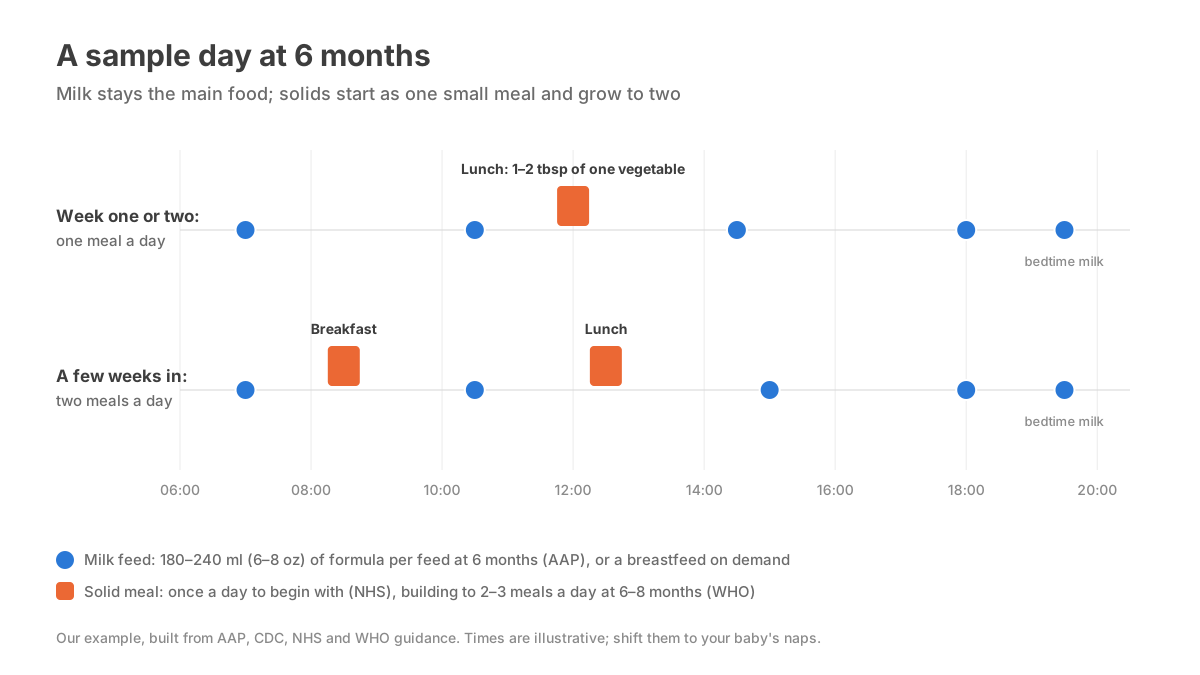
A sample day at 6 months, built from AAP, CDC, NHS and WHO guidance. Times are illustrative.
How much milk does a 6 month old need?
Milk remains the main food. The CDC puts it plainly: "Breast milk and/or infant formula continues to be the main source of nutrition for your child from 6 to 12 months." The NHS says the same for the UK: your baby "will still be getting most of their energy and nutrients from breast milk or first infant formula."
Breastfed babies feed on demand everywhere. No major body gives a volume, because you cannot measure it and do not need to. The NHS says to keep offering breastfeeds on demand and to offer the milk feed after solids. The WHO recommends continuing to breastfeed "up to 2 years of age or beyond."
Formula-fed babies get a number from the AAP: by 6 months, "your baby will consume 6 to 8 ounces (180–240 mL) at each of 4 or 5 feedings in 24 hours," and "should usually drink no more than an average of about 32 ounces (960 mL) of formula in 24 hours." The NHS does not give a figure at 6 months. Its first guide amount appears in the 7 to 9 month stage: "formula-fed babies may need around 600ml of milk a day, but just use this as a guide," falling to around 400 ml a day at 10 to 12 months.
| Breastfed at 6 months | Formula-fed at 6 months | |
|---|---|---|
| US (AAP, CDC) | On demand; breast milk remains the main source of nutrition | 180–240 ml (6–8 oz) × 4–5 feeds; no more than ~960 ml (32 oz) a day (AAP) |
| UK (NHS) | On demand; offer the feed after solids | No fixed amount at 6 months; "around 600ml a day" as a guide from 7 months |
| Europe / WHO | Continue to 2 years or beyond (WHO); exclusive or predominant breastfeeding to about 6 months is the goal (ESPGHAN) | No volume given; feed to appetite |
Two cautions about the AAP figures. They are an average for a typical baby, and a smaller or larger baby will land either side of them. And once solids are established, formula intake drops on its own; the NHS says your baby "will adapt their feeds according to how much food they're having."
How much solid food should a 6 month old eat?
Less than most parents expect. Here is how each body describes the starting amount:
- CDC: "Give 1 or 2 tablespoons of food." It adds that children's stomachs are small and to "watch for signs that they are still hungry or full."
- AAP: "Start with half a spoonful or less," then "a teaspoonful or two," building over time so that each daily meal is eventually "about 4 ounces, or the amount in one small jar of strained baby food."
- NHS: "start by offering them small amounts of food (just a few pieces, or teaspoons of food)," and "trust your baby to eat as much or as little as they want."
- WHO: "start at 6 months with small amounts of food and increase gradually as the child gets older."
One to two tablespoons is about 15–30 g of mashed vegetable, or two or three finger-sized strips of soft food if you are doing baby-led weaning rather than purees. Most of it will end up on the tray in the first week. That is normal; the point at 6 months is practice, taste and texture, not calories.
What goes in those tablespoons matters more than the volume. The AAP asks you to "be sure to include foods that provide iron and zinc, such as baby food made with meat or iron-fortified cereals," and EFSA notes that some babies, especially exclusively breastfed ones whose mothers had low iron, "may benefit from earlier introduction of complementary foods that are a source of iron." Our iron-rich first foods guide lists the options.
How many meals a day should a 6 month old have?
Start with one. The NHS's Best Start in Life guidance says, "To start with, your baby only needs a small amount of solid food, once a day," at a time that suits you both. Pick a moment when your baby is alert and not ravenous: an hour or so after a milk feed works for many families.
Build to two or three. The WHO suggests "2–3 meals per day for infants 6–8 months of age," rising to "3–4 meals per day for infants 9–23 months." The NHS describes the same path in its own words: from about 7 months babies "gradually move towards eating 3 meals a day," and from about 10 months they should be on three meals. The CDC counts milk and food together and says a baby of this age eats or drinks "every 2 to 3 hours, or 5 or 6 times a day," which it describes as roughly three meals and two to three snacks, milk feeds included.
No separate snacks yet. The NHS is explicit: "Babies under 12 months do not need snacks. If you think your baby is hungry in between meals, offer extra milk feeds instead." The WHO mentions "1–2 additional snacks as required," but only from 6 months onward and only if needed.
How quickly you move from one meal to two is up to your baby. A reasonable pattern is one meal a day for the first one to two weeks, two meals by the end of the first month, and three meals by 8 or 9 months, with milk feeds in between. Our guide to fitting solids around milk feeds goes into the timing.
Where US, UK and European guidance differs
The outline is the same everywhere; the details are not. These are the points where the advice genuinely diverges, with the body behind each position.
| Question | US (AAP, CDC) | UK (NHS) | Europe / international (EFSA, ESPGHAN, WHO) |
|---|---|---|---|
| When to start | AAP: breast milk alone for "approximately 6 months"; CDC: "about 6 months" and "not before 4 months" | "Around 6 months," once the three readiness signs appear together | EFSA: "the majority of infants need complementary foods from around 6 months"; ESPGHAN: not before 4 months (17 weeks) and not later than 6 months (26 weeks); WHO: 6 months |
| Gap between new foods | "Wait 3 to 5 days between each new food" (CDC); "every 3 to 5 days" (AAP) | No set gap; introduce allergenic foods "1 at a time and in small amounts so you can spot any reaction" | No gap specified; EFSA sees "no reason to postpone" allergenic foods and says gluten can go in with other foods |
| First foods | Any food group, with iron- and zinc-rich foods included early (AAP); a variety of fortified cereals rather than rice alone (CDC) | Single vegetables and fruit, starting with "vegetables that aren't so sweet, such as broccoli, cauliflower and spinach" | Iron-rich foods matter most for babies at risk of iron depletion (EFSA); otherwise no prescribed order |
| Meals a day at 6 months | Not specified as a count; 5–6 eating occasions including milk (CDC) | Once a day to begin with | 2–3 meals a day at 6–8 months (WHO) |
| Milk before or after solids | Not specified | Solids first, then the milk feed | Not specified |
| Snacks before 12 months | Counted within the 5–6 daily eating occasions (CDC) | None needed; offer extra milk instead | "1–2 additional snacks as required" (WHO) |
The 3-to-5-day rule is the difference parents notice most. If you are in the US and follow it, a new food every four days means roughly seven or eight new foods a month, which is slow enough that the 100 first foods idea only makes sense as a year-long project.
Families following NHS or EFSA guidance can move faster and still keep the one-new-allergen-at-a-time rule, which is the part every body agrees on. Our allergens 101 guide explains how to introduce the common allergens either way.
A sample day for a 6 month old
These two days are examples we built from the guidance above, not a schedule any single body publishes. Milk amounts follow the AAP's formula range; breastfed babies simply feed on demand at the same points. Shift the times to match your baby's naps.
Week one or two: one meal a day
| Time | What |
|---|---|
| 7:00 | Milk feed (180–240 ml / 6–8 oz, or a breastfeed) |
| 9:30 | Nap |
| 10:30 | Milk feed |
| 12:00 | Solids: 1–2 tablespoons of a single vegetable, such as mashed broccoli or sweet potato, then a milk feed if wanted |
| 14:30 | Milk feed |
| 18:00 | Milk feed |
| 19:30 | Bedtime milk feed |
A few weeks in: two meals a day
| Time | What |
|---|---|
| 7:00 | Milk feed |
| 8:30 | Breakfast: 2–3 tablespoons of oatmeal made with breast milk or formula, mashed banana on the side |
| 10:30 | Milk feed |
| 12:30 | Lunch: mashed lentil and carrot, or a soft-cooked egg if egg is already introduced; water in an open cup |
| 15:00 | Milk feed |
| 18:00 | Milk feed |
| 19:30 | Bedtime milk feed |
By the second table the baby is on five milk feeds and two meals, which sits inside the CDC's "5 or 6 times a day" and the WHO's two to three meals. If a milk feed shrinks because lunch was big, that is the adjustment the NHS describes, not a problem.
Keeping track of what was offered, what went in and how your baby reacted is the hard part of this stage, especially with a four-day gap between foods. Avo Starting Solids logs each food, allergen and reaction with the date, and shows which of the foods suitable at 6 months you have not tried yet.
Which first foods work best at 6 months?
Any single food with a soft texture and no added salt or sugar is a reasonable start. These eight cover the groups the AAP and NHS mention, and each links to its serving guide:
- Avocado: soft, high in fat, needs no cooking
- Banana: mashed, or as a finger-length piece with a little peel left on as a handle
- Sweet potato: steamed and mashed, or as soft wedges
- Broccoli: steamed florets are a natural finger food and one of the NHS's "not so sweet" starters
- Oatmeal: a fortified or iron-rich grain the CDC prefers over rice cereal alone
- Egg: a common allergen the AAP, CDC, NHS and EFSA all say can be introduced now
- Peanut butter: thinned with water or milk, never as a blob or whole nut
- Salmon: flaked, boneless, a source of iron and omega-3
The NHS tip to begin with vegetables "that aren't so sweet" is about taste training rather than nutrition, and it is the one point where UK and US advice part ways on first foods: the AAP says "there is no evidence" that starting with fruit makes babies dislike vegetables.
When should I ask a doctor about my 6 month old's feeding?
Most of the bumps at this stage, a day of refusing solids, a smaller milk feed after a big lunch, a few days of messier nappies, settle on their own. Talk to your paediatrician, GP or health visitor if your baby:
- consistently takes much less milk than before and is not making it up with solids
- is not gaining weight along their usual curve
- gags and coughs on every texture, or seems unable to move food to the back of the mouth; our gagging vs choking guide explains what is normal
- has a rash, swelling, vomiting or diarrhoea shortly after a new food (and call emergency services for any breathing difficulty or floppiness)
- was born prematurely, in which case the NHS says to get individual advice on timing from a health visitor or GP
The readiness age is also individual. The CDC says not to start before 4 months and the AAP that readiness "depends on their own rate of development," so a baby who is not sitting with support or still pushes food out with the tongue at 6 months may simply need another week or two.
Frequently asked questions
How many ounces of formula should a 6 month old drink?
The American Academy of Pediatrics says a 6 month old typically takes 6 to 8 ounces (180–240 ml) at each of 4 or 5 feedings, and no more than an average of about 32 ounces (960 ml) in 24 hours. The NHS gives no fixed amount at 6 months and says to feed on demand; its first guide figure is around 600 ml a day for formula-fed babies at 7 to 9 months.
How much solid food should a 6 month old eat per meal?
Very little at first. The CDC says to give 1 or 2 tablespoons; the AAP says to start with half a spoonful or less and work up to about 4 ounces (120 g) per meal over time; the NHS says a few teaspoons or a few pieces of finger food. Your baby's appetite, not the chart, sets the amount.
Should a 6 month old have solids once or twice a day?
Once a day is enough to begin with, according to the NHS. The World Health Organization suggests 2 to 3 meals a day for babies aged 6 to 8 months, so most families add a second meal within a few weeks, once the first one is going well.
Should I give milk before or after solids at 6 months?
The NHS advises offering solids first and the milk feed afterwards, so that milk is not displaced before the baby is eating meaningful amounts. The AAP and CDC do not specify an order; many parents offer solids an hour or so after a milk feed, when the baby is neither starving nor full.
Does my 6 month old need snacks or water?
No snacks: the NHS says babies under 12 months do not need them and suggests an extra milk feed instead. Water is different. Both the NHS and the CDC say to offer sips of plain water from an open or free-flow cup at mealtimes once solids start.
Sources
The guidance in this article comes from these bodies. The badge shows which region's rules each one sets.
- USAAP HealthyChildren.org — Starting Solid Foods
- USAAP HealthyChildren.org — Amount and Schedule of Formula Feedings
- USCDC — When, What, and How to Introduce Solid Foods
- USCDC — How Much and How Often to Feed
- UKNHS — Your baby's first solid foods
- UKNHS Best Start in Life — What to feed your baby from around 6 months
- UKNHS Best Start in Life — What to feed your baby, 7 to 9 months
- EUEFSA — Appropriate age range for introduction of complementary feeding (2019)
- EUESPGHAN Committee on Nutrition — Complementary Feeding position paper (2017)
- WHOWHO — Infant and young child feeding fact sheet