Foods to Avoid During Pregnancy: The Complete List (US, UK and European Guidance Compared)
Every food to avoid or limit in pregnancy, grouped by risk, with what the NHS, FDA, CDC, ANSES and EFSA each say and where the US, UK and EU rules differ.
By the Avo Parenting teamPublished October 20, 202611 min read
In short
- Four risks drive the whole list: listeria (soft cheese, deli meat, smoked fish, pâté), toxoplasma (undercooked meat), mercury (shark, swordfish, marlin, king mackerel) and vitamin A (liver).
- Caffeine is capped at 200 mg a day by the NHS, EFSA and ACOG; alcohol has 'no known safe amount' (CDC) and is 'safest to avoid' (NHS).
- The cheese rule differs: the FDA allows soft cheese labelled 'made with pasteurized milk', the NHS says mould-ripened soft cheese only if cooked, and France's ANSES avoids most raw-milk and soft cheeses outright.
- Eggs differ too: the NHS allows runny British Lion eggs, while the FDA says no raw or undercooked eggs for anyone at higher risk, which includes pregnancy.
- Sushi with raw fish is off the UK list even when previously frozen (NHS); cooked sushi, cooked shellfish and low-mercury fish up to 2 to 3 servings a week are encouraged everywhere.
The pregnancy avoid list looks long because it is written food by food. Behind it sit only four risks: a bacterium that grows in the fridge (listeria), a parasite in undercooked meat and soil (toxoplasma), a metal that builds up in big fish (mercury) and a vitamin that is toxic in excess (vitamin A). Add two limits, caffeine and alcohol, and you have the whole list.
Which foods fall under each risk is where the UK's NHS, the US Food and Drug Administration (FDA) and Centers for Disease Control and Prevention (CDC), France's food safety agency ANSES, the European Food Safety Authority (EFSA) and Germany's national pregnancy recommendations differ. This guide groups every food by its risk, gives each body's rule, and marks the differences, so you can follow the advice for where you live and understand why a friend abroad was told something else.
If you want the answer for one specific food, our pregnancy food library rates hundreds of foods as safe, caution or avoid, and the guides below cover the most-asked ones.
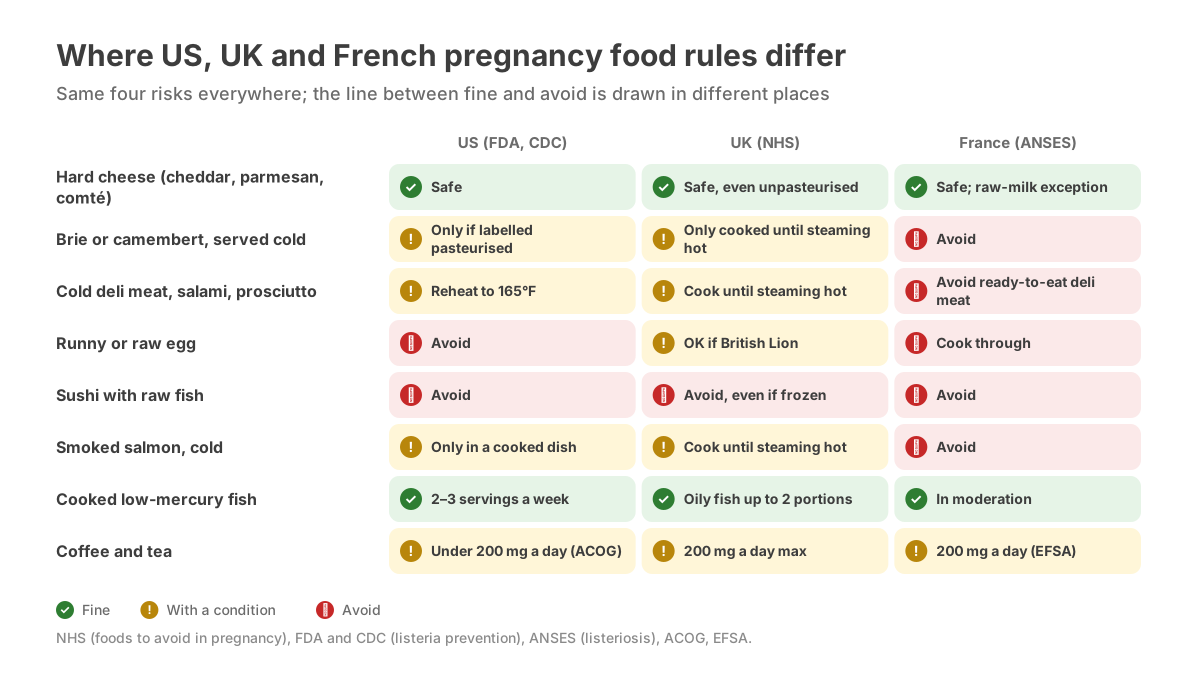
Where the US, UK and French rules draw the line between fine, conditional and avoid.
Which foods carry a listeria risk in pregnancy?
Listeria is the reason most of the list exists. The CDC says "about 1 in 25,000 pregnant women are infected with Listeria" each year in the US, that symptoms "are usually mild" and that "1 in 4 pregnant women who get this illness lose their pregnancy or their baby shortly after birth." It grows at fridge temperature, which is why the risky foods are chilled, ready-to-eat ones.
EFSA's 2018 opinion found that "more than 90% of invasive listeriosis is caused by ingestion of ready-to-eat food containing more than 2,000 colony forming units per gram," and that a third of cases are due to growth in the consumer's own fridge.
| Food | US (FDA, CDC) | UK (NHS) | Europe (ANSES, Germany) |
|---|---|---|---|
| Soft cheese: brie, camembert, chèvre | Avoid unless "labeled as made with pasteurized milk" (FDA) | Avoid unless "cooked until steaming hot" | ANSES: avoid "soft cheeses with a surface mould (such as Camembert, Brie and Crottin)" |
| Soft blue cheese | Same label test | Avoid unless cooked | ANSES: avoid washed-rind and short-ripened cheeses (Munster, Reblochon, Morbier); Germany warns on soft cheese "including those made from heat-treated milk such as Gorgonzola" |
| Unpasteurised milk and cheese | Avoid (FDA, CDC) | Avoid | ANSES: avoid raw-milk cheese "with the exception of hard pressed cheeses such as Gruyère and Comté" |
| Deli meat, cold cuts, hot dogs | Avoid unless "reheated to 165°F or until steaming hot" (CDC) | Cold cured meats "should be cooked until steaming hot"; pre-packed cooked meats are a listeria risk | ANSES: avoid "ready-to-eat cooked delicatessen meat" |
| Pâté, including vegetable pâté | Avoid "refrigerated pâté or meat spreads" (CDC) | Avoid all pâté (listeriosis page); keep chilled and within use-by if eaten | ANSES: avoid |
| Smoked fish: smoked salmon, trout | Avoid "refrigerated smoked fish" unless in a cooked dish (CDC) | Cold-smoked and cured fish "must be cooked until steaming hot" | ANSES: avoid smoked fish |
| Cold cooked prawns, cooked crustaceans | Not named | "Must be cooked until steaming hot" | ANSES: avoid "peeled crustaceans sold cooked" |
| Pre-made deli salads, pre-cut fruit, pre-packed sandwiches | Avoid "premade deli salads" and cut melon left out over 2 hours (CDC) | Listed as listeria sources on the NHS listeriosis page | ANSES: avoid "cheeses sold grated" and respect use-by dates |
| Raw sprouts | Avoid "raw or lightly cooked sprouts" (CDC) | Not named | Not named |
The pattern is that the US tests by label (pasteurised or not, reheated or not), the UK tests by cooking (steaming hot makes almost anything acceptable), and France tests by cheese type regardless of pasteurisation. All three agree on hard cheese, cooked food and anything heated through. For the per-food detail see our guides on feta, deli meat, prosciutto, pepperoni, hot dogs and smoked salmon, and the full cheese in pregnancy and listeria in pregnancy articles.
Which foods carry a toxoplasma or salmonella risk?
Toxoplasma lives in undercooked meat, unwashed produce and cat litter. The infection is mild for the mother and dangerous for the fetus, and it is the reason every body wants meat cooked through.
- Undercooked meat. The NHS: "raw or undercooked meat", with poultry and pork cooked until "there's no pink or blood", and "rolled joints of meat – must be thoroughly cooked all the way through." The CDC gives temperatures: whole cuts to at least 145°F (63°C) with a three-minute rest, ground meat to 160°F (71°C), poultry to 165°F (74°C), and notes that freezing meat "for several days at sub-zero (0°F) temperatures before cooking" greatly reduces the risk. Germany's recommendations name "raw sausage meat such as salami or raw ham" as "particularly problematical."
- Raw and lightly cooked eggs. This is a country difference. The NHS says hen eggs "that have the red British Lion stamp or are produced under the Laid in Britain scheme can be eaten raw" or runny; other hen eggs, and all duck, goose and quail eggs, "should only be eaten well-cooked." The FDA puts "raw or undercooked eggs or foods containing raw or undercooked eggs" on the avoid list for higher-risk groups and warns about restaurant Caesar dressing, custards and sauces. Outside the UK there is no Lion scheme, so the US rule is the safe default across Europe.
- Raw shellfish and raw fish. Avoid raw oysters, clams and mussels (CDC: "may be contaminated with Toxoplasma"; NHS: "raw fish and raw shellfish"; ANSES: "raw shellfish, raw fish (sushi, sashimi, taramasalata)"). Cooked shellfish is fine everywhere: the NHS lists "cooked shellfish, including prawns, crab, lobster" as safe. See can I eat sushi, shrimp and crab.
- Unwashed produce, soil and cat litter. Rinse fruit and vegetables under running water, wear gloves in the garden, and have someone else change the litter daily (CDC).
Which fish should I avoid or limit in pregnancy?
Fish is encouraged in pregnancy by every body, for omega-3 and iodine, with two limits: mercury in large predatory fish, and pollutants in oily fish.
| Rule | US (FDA/EPA) | UK (NHS) | Europe |
|---|---|---|---|
| Fish to avoid entirely | King mackerel, marlin, orange roughy, shark, swordfish, Gulf of Mexico tilefish, bigeye tuna | Shark, swordfish, marlin | No single EU list; national lists follow the same species |
| How much fish | 2 to 3 servings a week from the "best choices" list, 4 oz (113 g) each | Oily fish "not more than 2 portions a week" | Germany: oily sea fish eaten "moderately" as part of a varied diet |
| Tuna | Light canned tuna is a "best choice"; albacore and yellowfin are "good choices", 1 serving a week | "Not more than 4 cans or 2 tuna steaks a week" | Follows national advice |
| Raw or smoked fish | Avoid raw fish and refrigerated smoked seafood | Avoid raw-fish sushi "even if it has been previously frozen"; cook smoked fish until steaming hot | ANSES: avoid raw fish and smoked fish |
The NHS tuna limit is the question we are asked most; our how much tuna and canned tuna guides have the can-by-can arithmetic.
Which foods are high in vitamin A, or carry other risks?
- Liver and liver products. The NHS says to avoid "liver and liver products" because they are "high in vitamin A, which can harm the baby." That includes liver pâté and liver sausage. Fish liver oil supplements are out for the same reason; a pregnancy multivitamin without retinol is the alternative.
- Game meat. The NHS adds "game meats such as goose, partridge, pheasant and venison" because they "may contain lead" shot.
- Liquorice root. "Liquorice root may be harmful to your baby's development, so it's safest to avoid it" (NHS); ordinary liquorice sweets are fine.
- Herbal teas. The NHS says to "avoid drinking more than 4 cups of herbal tea a day" because research is limited.
- Peanuts. Not on any list. The NHS: "peanuts and other nuts are safe to eat unless you've been told not to have them." Avoiding them does not prevent allergy in the baby.
- Honey. Safe in pregnancy. The honey rule applies to babies under 1, not to you; see can I eat honey pregnant.
How much caffeine and alcohol is allowed in pregnancy?
Caffeine: 200 mg a day, everywhere. The NHS: "you should not have more than 200mg of caffeine a day", noting that high intakes "have been linked to miscarriage and stillbirth." EFSA's 2015 assessment sets 200 mg a day, consumed throughout the day, as safe for the fetus, and Germany's national recommendations adopt it. ACOG's committee opinion says moderate consumption "less than 200 mg per day does not appear to be a major contributing factor in miscarriage or preterm birth." The figure covers coffee, tea, cola, energy drinks and chocolate together; our caffeine and matcha guides have the per-cup numbers.
Alcohol: none is the only agreed safe amount. The CDC: "There is no known safe amount of alcohol use during pregnancy", "no safe time" and "all types of alcohol can be harmful." The NHS: "it's safest to avoid alcohol." Germany's recommendation is the firmest: women who are planning a pregnancy and pregnant women "must avoid alcohol", because "it is not possible to define a safe and risk-free amount of alcohol for the fetus."
Where US, UK and European guidance differs
| Question | US | UK | Europe |
|---|---|---|---|
| Soft cheese | OK if labelled pasteurised (FDA) | Mould-ripened and blue only if cooked (NHS) | ANSES avoids by type; Germany warns even on pasteurised soft cheese |
| Runny eggs | Avoid (FDA) | OK if British Lion or Laid in Britain (NHS) | No equivalent scheme; cook through |
| Raw-fish sushi | Avoid when eating out (FDA) | Avoid, even previously frozen (NHS) | Avoid (ANSES) |
| Deli meat | OK reheated to 165°F (CDC) | OK cooked until steaming hot (NHS) | ANSES: avoid ready-to-eat deli meat |
| Fish list | Seven species, servings by list (FDA/EPA) | Three species, plus a tuna cap (NHS) | National lists |
| Liver | Not a headline item | Avoid (NHS) | Germany: vitamin A caution |
| Caffeine | Under 200 mg (ACOG) | 200 mg max (NHS) | 200 mg (EFSA) |
| Alcohol | No known safe amount (CDC) | Safest to avoid (NHS) | Must avoid (Germany) |
The differences are real but narrow: cheese, eggs and sushi. On everything else, the lists line up, and the safest reading is the strictest one that applies to you.
How do I eat out and shop safely while pregnant?
The food is only half of listeria; the other half is time and temperature. The FDA's eating-out advice is to "always request that your food be cooked thoroughly, especially meat, poultry, fish, and eggs", to send lukewarm food back, to ask for raw sprouts to be left off, and not to take leftovers home "if you won't be arriving home within 2 hours of being served."
Germany's recommendations say that in restaurants and cafeterias pregnant women "should where possible consume food that has been heated immediately prior to consumption." ANSES's fridge rules apply at home: 4°C, respect use-by dates, store leftovers no more than three days, reheat above 70°C.
Checking a plate or a menu against all of this is what Avo Pregnancy is for: scan the dish or the menu and it shows which items are safe, which need to be cooked through, and which to skip, with the guidance behind each answer. Our eating out while pregnant guide walks through a restaurant menu course by course.
What should I do if I ate something on this list?
First, do not panic: the risk from a single exposure is small, and most listeria and toxoplasma exposures never become infections. Then:
- Note what and when. Listeria symptoms "usually start within 2 weeks" for invasive illness (CDC) and can be as mild as "a fever and feel more tired and achy than normal."
- Watch for symptoms, including fever, aches, chills, nausea or diarrhoea, and, the NHS adds, stomach ache or "reduced baby movement."
- Call if symptoms appear. The NHS says to ask for an urgent GP appointment or call 111 if you are pregnant and think you may have listeriosis; in the US call your obstetrician. Antibiotics treat it.
- Do not wait for symptoms if the food was recalled. Tell your doctor; some will test or treat on the basis of exposure alone.
Our I ate something I shouldn't have guide covers the scenarios one by one.
Frequently asked questions
Can I eat deli meat while pregnant?
Not cold. The CDC says to avoid 'unheated deli meat, cold cuts, hot dogs, and fermented or dry sausages' and to reheat them to 165°F (74°C) or until steaming hot. The NHS says cold cured meats such as salami, pepperoni, chorizo and prosciutto 'should be cooked until steaming hot'. Pre-packed cooked ham is a listeria risk in both countries for the same reason.
What cheese can I eat during pregnancy?
Hard cheese, pasteurised or not: cheddar, gruyère, parmesan, comté. Pasteurised soft cheese such as cottage cheese, cream cheese, mozzarella and feta made with pasteurised milk. Any cheese cooked until steaming hot. Avoid mould-ripened soft cheese (brie, camembert, chèvre), soft blue cheese and anything unpasteurised unless cooked, per the NHS; the FDA says the same with the label 'made with pasteurized milk' as the test.
How much caffeine is safe in pregnancy?
200 mg a day. The NHS says 'you should not have more than 200mg of caffeine a day', EFSA sets the same figure as safe for the fetus, and ACOG says moderate consumption under 200 mg 'does not appear to be a major contributing factor in miscarriage or preterm birth'. That is roughly one large filter coffee, two espressos or three cups of tea.
Is sushi safe in pregnancy?
Cooked sushi, yes; raw fish sushi depends on where you are. The NHS says to avoid 'sushi made with raw fish (even if it has been previously frozen) or raw shellfish'. The FDA tells pregnant women to skip raw or undercooked fish, shellfish, sushi and sashimi when eating out. France's ANSES lists sushi, sashimi and taramasalata among foods to avoid.
What happens if I ate something on the avoid list?
Usually nothing. The CDC says about 1 in 25,000 pregnant women are infected with listeria each year, so a single exposure is a small risk. Watch for a fever, aches or feeling unusually tired over the next two weeks, and call your midwife, GP or obstetrician if they appear, because listeriosis is treatable with antibiotics when caught early.
Sources
The guidance in this article comes from these bodies. The badge shows which region's rules each one sets.
- UKNHS — Foods to avoid in pregnancy
- UKNHS — Listeriosis
- USFDA — Food Safety for Moms-to-Be: At a Glance
- USFDA — Food Safety for Moms-to-Be: Eating Out and Bringing In
- USFDA / EPA — Advice About Eating Fish
- USFDA — People at Risk of Foodborne Illness
- USCDC — Preventing Listeria Infection
- USCDC — Listeria Infection: People at Increased Risk
- USCDC — Symptoms of Listeria Infection
- USCDC — Preventing Toxoplasmosis
- USCDC — About Alcohol Use During Pregnancy
- USACOG Committee Opinion No. 462 — Moderate Caffeine Consumption During Pregnancy
- EUANSES — Listeriosis and how you can prevent it
- EUEFSA — Caffeine: scientific opinion summary (2015)
- EUEFSA — Listeria monocytogenes contamination of ready-to-eat foods and the risk for human health in the EU (2018)
- EUGermany, Healthy Start – Young Family Network — Diet and lifestyle before and during pregnancy (2018)