Listeria in Pregnancy: Which Foods Carry the Risk, Symptoms, and What to Do If You Ate Something
Listeria is rare but serious in pregnancy. The foods that carry it, the symptoms to watch for, how long they take to appear, and what the CDC, NHS, ANSES and EFSA advise.
By the Avo Parenting teamPublished October 20, 20268 min read
In short
- About 1 in 25,000 pregnant women in the US are infected each year, and 1 in 4 of those lose the pregnancy or the baby shortly after birth (CDC).
- The risky foods are chilled, ready-to-eat ones: soft cheese, deli meat, pâté, smoked fish, pre-made salads, unpasteurised milk (CDC, NHS, ANSES).
- Symptoms in pregnancy are 'usually mild', a fever and feeling tired and achy, and invasive illness 'usually starts within 2 weeks' of eating the food (CDC).
- Heat kills listeria: food 'cooked until steaming hot' or reheated to 165°F (74°C) is safe (NHS, CDC); a fridge at 4°C or below slows it (ANSES, FDA).
- EFSA found that over 90% of invasive cases come from ready-to-eat food with high bacterial counts, and a third from growth in the consumer's own fridge.
Listeria is the reason pregnant women are told to avoid brie, cold deli meat and smoked salmon, and it is worth understanding on its own, because the rules make much more sense once you know how the bacterium behaves. It grows in the fridge, it is killed by heat, and it causes a mild illness in the mother that can be severe for the baby.
This guide sets out what the US Centers for Disease Control and Prevention (CDC) and Food and Drug Administration (FDA), the UK's NHS, France's ANSES and the European Food Safety Authority (EFSA) say about the risk, the foods, the symptoms and the steps to take after an exposure.
The American College of Obstetricians and Gynecologists (ACOG) publishes a patient FAQ on the same subject; its site was not reachable when this article was checked, so its figures are not quoted here.
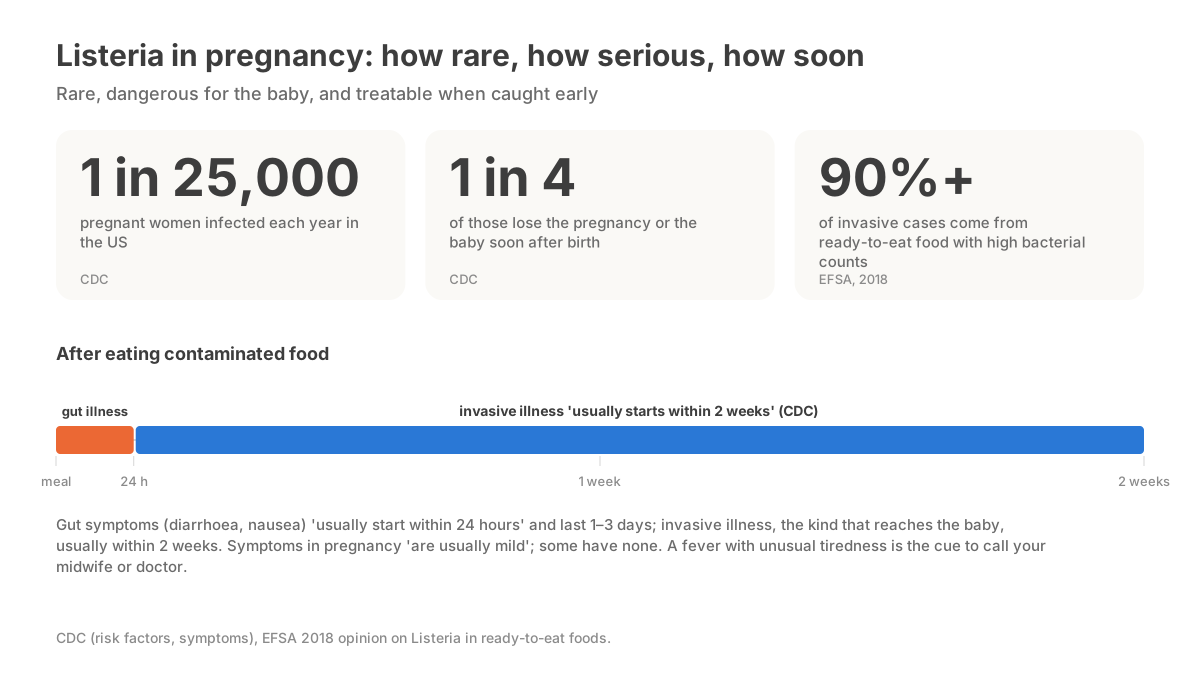
How rare, how serious and how soon: CDC risk and symptom figures with EFSA's 2018 finding on ready-to-eat food.
How dangerous is listeria in pregnancy?
Rare, and serious when it happens. The CDC's numbers: "about 1 in 25,000 pregnant women are infected with Listeria" each year in the US, and "1 in 4 pregnant women who get this illness lose their pregnancy or their baby shortly after birth." Its symptoms page says infection during pregnancy "usually leads to miscarriage, stillbirth, premature delivery, or life-threatening infection of the newborn," and that this can happen "even when the mother does not feel very sick."
The NHS gives the same picture in fewer words: "there is a risk it could cause miscarriage or stillbirth." Pregnant people are listed with newborn babies, older people and people with a weakened immune system as the groups at higher risk.
EFSA's 2018 opinion adds the European trend: invasive listeriosis in the EU rose over 2008 to 2015, including in women aged 25 to 44, "probably related to pregnancies."
Its modelling found that "more than 90% of invasive listeriosis is caused by ingestion of ready-to-eat food containing more than 2,000 colony forming units per gram," and that "one-third of cases are due to growth in the consumer phase," meaning in your own fridge after purchase. That is why the advice is as much about storage and dates as about which food.
Which foods carry listeria?
Chilled, ready-to-eat foods that are not cooked again before eating. The lists are nearly identical across the three regions; the table shows each body's wording.
| Food group | US (CDC, FDA) | UK (NHS) | France (ANSES) |
|---|---|---|---|
| Soft cheese | Avoid any cheese "made with (raw) unpasteurized milk"; soft cheese only if "labeled as made with pasteurized milk"; unheated queso fresco flagged | Mould-ripened soft cheese and soft blue cheese unless "cooked until steaming hot"; all unpasteurised cheese | Surface-mould, washed-rind, short-ripened pressed and grated cheeses; raw-milk cheese except hard pressed (gruyère, comté) |
| Deli and cured meat | "Unheated deli meat, cold cuts, hot dogs, and fermented or dry sausages" unless "reheated to 165°F or until steaming hot" | Cold cooked sliced meats and cold cured meats (salami, chorizo, prosciutto) unless cooked until steaming hot | "Ready-to-eat cooked delicatessen meat" |
| Pâté | "Refrigerated pâté or meat spreads" | All pâté, including vegetable pâté | Not named separately; covered by deli meat |
| Smoked and cured fish | "Refrigerated smoked fish" unless in a cooked dish | Cold-smoked and cured fish, including sushi made with it, unless steaming hot | "Smoked fish" |
| Cooked seafood sold cold | Not named | Cold ready-to-eat prawns unless cooked until steaming hot; cooked shellfish on the listeriosis list | "Peeled crustaceans sold cooked" |
| Pre-made salads and cut produce | "Premade deli salads"; cut melon left out over 2 hours or kept over a week | Pre-prepared sandwiches and salads, pre-cut fruit | Respect use-by dates on high-risk foods |
| Raw sprouts and raw mushrooms | "Raw or lightly cooked sprouts"; raw enoki and other mushrooms for people at increased risk | Not named | Not named |
| Unpasteurised milk, cream, ice cream | Raw milk and foods made from it | "Unpasteurised milk, cream, yoghurt, butter and ice cream" | Raw milk and raw-milk products |
What is not on any list: hard cheese, cooked food eaten hot, canned and shelf-stable products in sealed packaging (the CDC names shelf-stable pâté and smoked fish as safer choices), pasteurised fresh cheese, and anything you cook yourself and eat promptly. For the cheese question in detail see cheese in pregnancy, and for the full avoid list foods to avoid during pregnancy.
What are the symptoms of listeriosis in pregnancy?
Mild, late and easy to miss, which is the point of the food rules.
- In the mother: the CDC says symptoms "are usually mild" and that "some pregnant women never have symptoms"; its trigger for calling a provider is "a fever and feel more tired and achy than normal." The NHS lists a high temperature, aches and pains, chills, feeling or being sick and diarrhoea, and for pregnant people adds a stomach ache or noticing "reduced baby movement."
- Timing: for invasive illness, "symptoms usually start within 2 weeks after eating food contaminated with Listeria" (CDC). The milder gut form "usually starts within 24 hours" and lasts one to three days.
- Severe signs in anyone: the NHS says to call 999 or go to A&E for a severe headache with a stiff neck, discomfort from bright lights, a seizure, sudden confusion, extreme sleepiness or a rash that does not fade under pressure, because these can signal meningitis.
- In a newborn: the NHS notes babies "may be irritable and feed less than usual."
The mismatch between a mild illness in the mother and a severe one in the baby is why doctors treat suspected cases quickly. The CDC's symptoms page puts the death rate for invasive listeriosis not linked to pregnancy at "almost 1 in 6," which is the other reason the bacterium is taken seriously.
What should I do if I ate a risky food?
- Write down what and when. The two-week window starts from the meal, not from when you remembered it.
- Do nothing else for now if you feel well. The odds from one exposure are low, and there is no preventive treatment to take at home.
- Watch for symptoms for two weeks: fever, aches, chills, nausea, diarrhoea, stomach ache, reduced movements.
- Call if any appear. The NHS: ask for an urgent GP appointment or call 111 if you are pregnant and think you might have listeriosis. In the US, call your obstetrician or midwife; the CDC's advice is to call if you have "a fever and feel more tired and achy than normal."
- Call anyway if the food was recalled. A recall means the product was found to contain listeria, and many clinicians will test or start antibiotics on exposure alone.
Listeriosis is treated with antibiotics, and treatment during pregnancy can protect the baby, which is why the "call early" advice is consistent across every body. Our I ate something I shouldn't have guide covers specific foods.
How do I prevent listeria at home?
The bacterium's two weaknesses are heat and time.
- Heat. "Cooking kills listeria" (NHS), so anything heated "until steaming hot right through" is safe, including soft cheese, smoked fish and deli meat. The CDC's number for deli meats and hot dogs is 165°F (74°C); ANSES asks for leftovers to be reheated "to an internal temperature above +70°C."
- Cold, but not for long. Keep the fridge at "5C or below" (NHS), "40°F (4°C) or below" (FDA) or "4°C" (ANSES), put high-risk foods in the coldest part, and remember that cold only slows listeria. ANSES: "store leftovers for no more than three days."
- Dates. "Eat, cook or freeze foods by their use-by date" (NHS); "respect use-by dates and periods after opening" (ANSES). The CDC's melon rule is the same idea: cut melon left out over two hours, or in the fridge over a week, goes in the bin.
- Hygiene. Wash hands before preparing food, clean surfaces and utensils that touched high-risk foods, and keep raw and ready-to-eat foods apart.
- When eating out, Germany's national recommendations say to choose, "where possible, food that has been heated immediately prior to consumption," and the FDA says to send lukewarm food back. Our eating out while pregnant guide applies this to a menu.
Avo Pregnancy folds these rules into its food checks: scan a product or a dish and it tells you whether listeria is the concern, whether cooking fixes it, and which body says so, so the decision at the deli counter takes seconds rather than a search.
Where US, UK and European guidance differs
| Question | US (CDC, FDA) | UK (NHS) | Europe (ANSES, EFSA, Germany) |
|---|---|---|---|
| Soft cheese test | Pasteurisation label | Cooking | Cheese category, regardless of pasteurisation |
| Deli meat | OK reheated to 165°F | OK cooked until steaming hot | ANSES: avoid ready-to-eat deli meat |
| Raw sprouts and mushrooms | On the list | Not named | Not named |
| Fridge temperature | 40°F (4°C) or below | 5°C or below | 4°C (ANSES) |
| Leftovers | 2-hour rule for perishables | By use-by date | No more than 3 days (ANSES) |
| Statistics cited | 1 in 25,000 pregnancies; 1 in 4 pregnancy losses among cases | Risk of miscarriage or stillbirth | Rising incidence in women 25 to 44; over 90% of cases from high-count ready-to-eat food (EFSA) |
The disagreements are about which cold foods are tolerable, never about hot ones. If you want one rule that satisfies every body: cold ready-to-eat food only when hard, pasteurised and inside its date; everything else heated through.
Frequently asked questions
How common is listeria in pregnancy?
Rare. The CDC says about 1 in 25,000 pregnant women in the United States are infected with listeria each year. Pregnant women are a recognised higher-risk group alongside newborns, older people and people with weakened immunity (NHS), which is why the food list exists, but the odds from any single meal are small.
What are the symptoms of listeria in pregnancy?
Often none, or a mild flu-like illness. The CDC says symptoms in pregnant women 'are usually mild' and some 'never have symptoms'; its advice is to call your provider if you have a fever and feel more tired and achy than normal. The NHS lists a high temperature, aches, chills, nausea, diarrhoea, and in pregnancy a stomach ache or reduced baby movement.
How long after eating does listeria show up?
The CDC says symptoms of invasive illness 'usually start within 2 weeks' after eating contaminated food, while the milder intestinal form starts within about 24 hours and lasts one to three days. Most official advice therefore asks you to watch for symptoms for two weeks after a known exposure, and some clinicians extend that window.
What should I do if I ate something that might have listeria?
Note what you ate and when, do not take anything in the meantime, and watch for a fever, aches or unusual tiredness over the next two weeks. The NHS says to ask for an urgent GP appointment or call 111 if you are pregnant and think you may have listeriosis. If the product was recalled, tell your doctor straight away; they may test or treat without waiting for symptoms.
Does cooking kill listeria?
Yes. The NHS says cooking kills listeria and that any food 'cooked until steaming hot' is safe, including soft and blue cheese and smoked fish. The CDC's figure for deli meats and hot dogs is 165°F (74°C). ANSES asks for reheating to an internal temperature above 70°C. Cold storage only slows growth; it does not stop it.
Sources
The guidance in this article comes from these bodies. The badge shows which region's rules each one sets.
- USCDC — Listeria Infection: People at Increased Risk
- USCDC — Symptoms of Listeria Infection
- USCDC — Preventing Listeria Infection
- USFDA — Food Safety for Moms-to-Be: At a Glance
- USFDA — Food Safety for Moms-to-Be: Eating Out and Bringing In
- UKNHS — Listeriosis
- UKNHS — Foods to avoid in pregnancy
- EUANSES — Listeriosis and how you can prevent it
- EUEFSA — Listeria monocytogenes contamination of ready-to-eat foods and the risk for human health in the EU (2018)
- EUGermany, Healthy Start – Young Family Network — Diet and lifestyle before and during pregnancy (2018)