Cheese in Pregnancy: Which Cheeses Are Safe (Brie, Camembert, Blue, Mozzarella, Halloumi, Paneer)
Hard cheese is safe, pasteurised soft cheese is safe, and brie, camembert and blue are safe cooked. What the NHS, FDA, CDC and France's ANSES say, cheese by cheese.
By the Avo Parenting teamPublished October 20, 20267 min read
In short
- Hard cheese is safe in pregnancy whether pasteurised or not: cheddar, parmesan, gruyère, comté, manchego (NHS, ANSES).
- Pasteurised soft cheeses are safe: mozzarella, feta, cottage cheese, cream cheese, ricotta, halloumi, paneer, goat's cheese without a rind (NHS, FDA).
- Mould-ripened soft cheese (brie, camembert, chèvre) and soft blue cheese (gorgonzola, roquefort, danish blue) are a listeria risk unless 'cooked until steaming hot' (NHS).
- The rules differ: the FDA accepts soft cheese 'labeled as made with pasteurized milk', the NHS does not for mould-ripened types, and ANSES avoids raw-milk cheese except hard pressed ones like gruyère and comté.
- Unpasteurised (raw-milk) soft cheese is off the list everywhere; cooked, any cheese is fine.
Most cheese is fine in pregnancy. The two kinds that are not, unless cooked, are soft cheeses that ripen with mould on the outside (brie, camembert, chèvre with a rind) and soft blue cheeses (gorgonzola, roquefort, danish blue). Add anything made from unpasteurised milk, and the avoid list is complete.
The reason is listeria, a bacterium that grows in the fridge and in moist, low-acid cheese, and which is dangerous in pregnancy: the CDC says infection "usually leads to miscarriage, stillbirth, premature delivery, or life-threatening infection of the newborn" even when the mother's symptoms are mild. The cure is heat. Any cheese "cooked until steaming hot," in the NHS's phrase, is safe.
Where the UK's NHS, the US FDA and CDC, and France's ANSES differ is in how they draw the line between safe and risky soft cheese: by cooking, by pasteurisation label, or by cheese type. This guide gives all three, cheese by cheese.
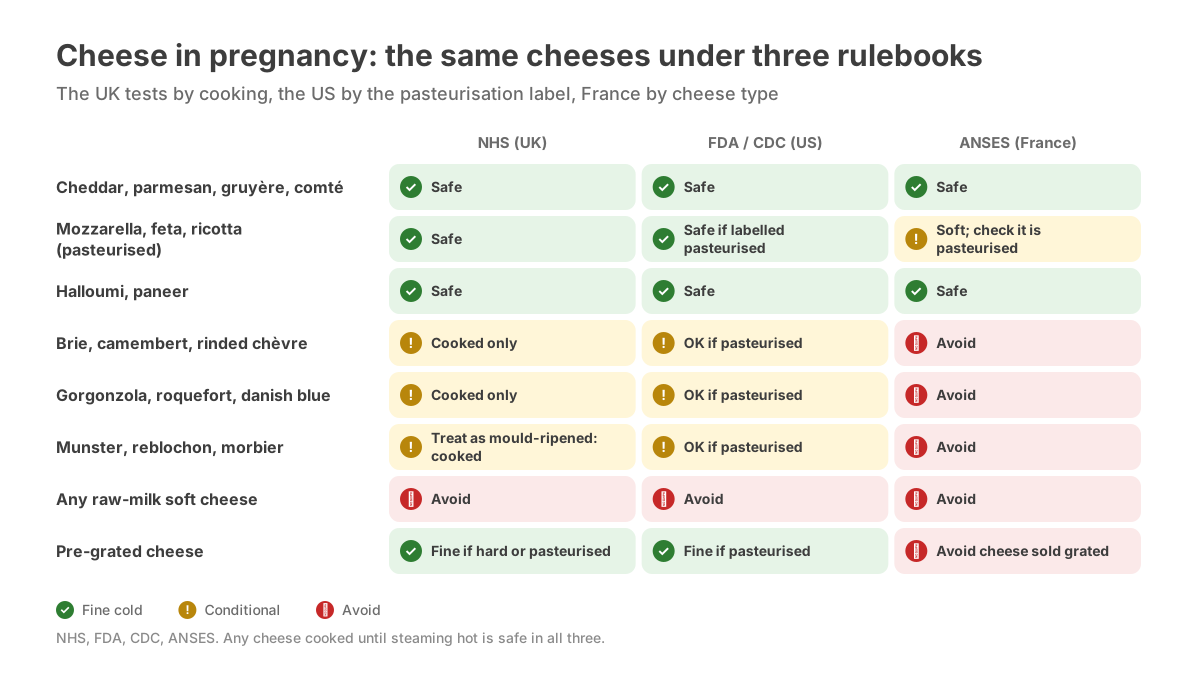
The same cheeses under three rulebooks. Any cheese cooked until steaming hot is safe in all three.
Which cheeses are safe in pregnancy?
Hard cheese, pasteurised or not. The NHS lists "pasteurised or unpasteurised hard cheeses, such as cheddar, gruyère and parmesan" as safe, because the low moisture and long ageing do not support listeria. ANSES makes the same exception for raw-milk cheese: avoid it "with the exception of hard pressed cheeses such as Gruyère and Comté." Add cheddar, parmesan, pecorino, manchego, emmental, edam, gouda and aged gruyère.
Pasteurised soft cheese. The NHS lists as safe "pasteurised soft cheeses, such as cottage cheese, cream cheese, processed cheese spreads, mozzarella, feta, paneer, ricotta, mascarpone, halloumi, burrata and goats' cheese that does not have a white coating (rind) on the outside," plus "pasteurised semi-hard cheeses, such as edam." The FDA's test is the label: soft cheese is fine when "labeled as made with pasteurized milk."
Any cooked cheese. "Any cheese that's been cooked until steaming hot, including soft or blue cheese" is safe (NHS). That makes baked brie, a blue-cheese sauce, camembert in the oven and pizza with any topping acceptable in every country.
Processed cheese. Cheese spreads, cheese slices and processed cheese are made from pasteurised milk and heat-treated; they are safe.
Which cheeses should I avoid in pregnancy?
| Cheese | Why | NHS (UK) | FDA / CDC (US) | ANSES (France) |
|---|---|---|---|---|
| Brie, camembert, chèvre with rind, chaource | Mould-ripened, moist, low acid | Avoid unless "cooked until steaming hot" | OK if "labeled as made with pasteurized milk" | Avoid "soft cheeses with a surface mould (such as Camembert, Brie and Crottin)" |
| Gorgonzola, roquefort, danish blue, dolcelatte | Soft blue-veined | Avoid unless cooked | OK if labelled pasteurised | Avoid; Germany's recommendations warn on soft cheese "including those made from heat-treated milk such as Gorgonzola" |
| Munster, pont-l'évêque, livarot, époisses, taleggio | Washed rind | Not named; treat as mould-ripened | Label test | Avoid "cheeses with a washed rind" |
| Reblochon, morbier, saint-nectaire, tomme (young) | Short-ripened uncooked pressed | Not named | Label test | Avoid "short-ripened uncooked pressed cheeses" |
| Any raw-milk soft cheese | Unpasteurised | Avoid "unpasteurised" cheeses | Avoid "any type of cheese when made with (raw) unpasteurized milk" (CDC) | Avoid raw-milk cheese except hard pressed |
| Queso fresco, queso blanco, panela (unpasteurised) | Fresh soft, often raw milk | Not named | CDC flags unheated queso fresco-type cheeses; pasteurised versions are safer choices | Not named |
| Pre-grated cheese | Handling, shelf life | Not restricted | Not restricted | Avoid "cheeses sold grated" |
Three practical points hide in that table. Stilton is not named by the NHS; it is a blue cheese, firmer than gorgonzola, and the cautious reading treats it like the other blues, cooked rather than cold. Goat's cheese is two different products: soft chèvre with a white rind is mould-ripened and must be cooked; a pasteurised goat's cheese log without a rind, or a hard goat's cheese, is fine.
And "soft blue" includes the cheeses in a pre-made blue-cheese dressing, which is served cold.
Cheese by cheese: a quick A to Z
Verdicts follow the NHS rule (cold if hard or pasteurised soft; cooked if mould-ripened, blue or unpasteurised), with the US and French differences noted where they change the answer.
- Brie: cooked only (NHS, ANSES); pasteurised OK in the US.
- Burrata: pasteurised OK; raw-milk versions cooked.
- Camembert: cooked only (NHS, ANSES); pasteurised OK in the US.
- Cheddar: safe, including unpasteurised and mature.
- Comté, gruyère, emmental: safe, including raw-milk (ANSES names them as the exception).
- Cottage cheese, cream cheese, quark, mascarpone: safe (pasteurised).
- Danish blue, dolcelatte, gorgonzola, roquefort: cooked only; stilton is not named by the NHS, so treat it the same way.
- Edam, gouda, jarlsberg: safe.
- Feta: safe if pasteurised; raw-milk feta cooked.
- Goat's cheese: rinded chèvre cooked only; rindless pasteurised log or hard goat's cheese safe.
- Halloumi: safe, usually eaten cooked anyway.
- Manchego, pecorino, parmesan, grana padano: safe.
- Mozzarella: safe if pasteurised, including buffalo mozzarella from a labelled pack.
- Munster, taleggio, époisses, reblochon: cooked only; ANSES avoids outright.
- Paneer: safe.
- Processed cheese, cheese slices, spreads: safe.
- Queso fresco, queso blanco: pasteurised OK; the CDC flags unheated fresh cheeses of this type, so check the label or cook.
- Ricotta: safe if pasteurised.
- Wensleydale, red leicester, double gloucester: safe.
Why do the UK, US and France disagree about brie?
Because they are managing the same risk at different points.
- The NHS reasons from the cheese: mould-ripened and soft blue cheeses have the moisture and acidity listeria likes, and contamination can happen after pasteurisation, during ripening. So pasteurisation does not clear them; cooking does.
- The FDA and CDC reason from the milk: most US listeria outbreaks tied to cheese have involved unpasteurised or Latin-style fresh cheeses, so the test is "made with pasteurized milk" on the label. The CDC still singles out "queso fresco-type cheeses" unless heated.
- ANSES reasons from French cheese culture, where raw-milk soft cheeses are common and often unlabelled at the counter. Its list avoids whole categories (surface mould, washed rind, short-ripened pressed, grated) regardless of pasteurisation, and exempts only hard pressed cheeses from the raw-milk rule. Germany's national recommendations go the same way, naming pasteurised gorgonzola as still high risk.
If you move between countries, the strictest rule that applies is the NHS's cooking test combined with ANSES's category list: hard cheese and clearly pasteurised fresh cheese cold, everything else hot. That is also the rule Avo Pregnancy applies when you scan a cheese board or a menu: it shows which cheeses are fine as they are and which need to be cooked, with the body behind each verdict.
What about cheese on a menu or in a sandwich?
Cheese is safest when you can see the label and least safe when you cannot. Three situations come up constantly:
- Pizza, lasagne, baked camembert, cheese sauce: cooked until steaming hot, so any cheese is fine (NHS).
- Cheese boards, salad bars, deli sandwiches: cold soft cheese of unknown origin. Ask whether the brie is pasteurised in the US, or skip it in the UK and France; take the hard cheeses.
- Pre-packed cold items: the NHS's listeriosis page lists pre-prepared sandwiches and salads among the chilled, ready-to-eat foods that cause most infections. Keep them cold, respect the use-by date, and prefer hard or pasteurised cheese fillings.
Our eating out while pregnant guide covers the rest of the menu, and the feta guide answers the single most-asked cheese question in more detail.
What should I do if I ate a risky cheese?
The chance that one portion of brie carries listeria is small, and most exposures cause no illness. The CDC's figure is that about 1 in 25,000 pregnant women are infected each year. Note what you ate and when, and watch for two weeks for a fever, aches, chills, nausea or diarrhoea, or, the NHS adds, stomach ache or reduced baby movement.
If any appear, ask for an urgent GP appointment or call 111 in the UK, or call your obstetrician in the US; listeriosis responds to antibiotics. Our I ate something I shouldn't have guide and the listeria in pregnancy article cover what happens next.
Frequently asked questions
Can I eat mozzarella while pregnant?
Yes, if it is pasteurised, which almost all supermarket mozzarella is. The NHS lists pasteurised soft cheeses as safe, and mozzarella is not mould-ripened or blue. Check the label on artisan or raw-milk (lait cru, latte crudo) mozzarella di bufala and avoid it unless cooked.
Can I eat brie or camembert when pregnant?
Only cooked. The NHS says mould-ripened soft cheeses with a white coating, such as brie, camembert and chèvre, should be eaten only when 'cooked until steaming hot', because the moist, low-acid cheese lets listeria grow. In the US the FDA accepts brie labelled 'made with pasteurized milk', but France's ANSES advises avoiding surface-mould cheeses altogether. Baked brie is fine everywhere.
Is feta safe in pregnancy?
Yes, if pasteurised, and in the UK and US most is. Feta is a brined soft cheese, not mould-ripened, so the NHS's pasteurised-soft-cheese rule applies. Raw-milk feta, sometimes sold in Greek delis, should be cooked. In France, ANSES would class most feta as a soft cheese to approach with caution unless it is clearly pasteurised.
Can I eat halloumi and paneer while pregnant?
Yes. Both are made from pasteurised milk in commercial production, both are typically cooked before eating, and neither is mould-ripened or blue. Grilled halloumi and cooked paneer are safe under NHS, FDA and ANSES guidance alike.
Is pre-grated or sliced cheese safe in pregnancy?
In the UK and US, pasteurised hard cheese stays safe grated. France's ANSES specifically lists 'cheeses sold grated' among foods for pregnant women to avoid, because of handling and shelf life. The practical rule everywhere is to keep it chilled, eat it within the use-by date and heat it in cooking when you can.
Sources
The guidance in this article comes from these bodies. The badge shows which region's rules each one sets.
- UKNHS — Foods to avoid in pregnancy
- UKNHS — Listeriosis
- USFDA — Food Safety for Moms-to-Be: At a Glance
- USCDC — Preventing Listeria Infection
- USCDC — Listeria Infection: People at Increased Risk
- USCDC — Symptoms of Listeria Infection
- EUANSES — Listeriosis and how you can prevent it
- EUGermany, Healthy Start – Young Family Network — Diet and lifestyle before and during pregnancy (2018)