Eating Out While Pregnant: A Restaurant and Menu Guide (Sushi, Steak, Salads, Buffets, Takeaway)
How to order safely when pregnant: what to ask for, which dishes to skip and why, course by course, with the FDA, NHS, ANSES and German guidance behind each answer.
By the Avo Parenting teamPublished October 20, 20267 min read
In short
- Order meat, poultry, fish and eggs cooked through and send lukewarm food back; the FDA's rule for pregnant diners is to 'always request that your food be cooked thoroughly'.
- Skip raw-fish sushi, raw oysters, steak tartare, rare burgers, raw sprouts and dressings made with raw egg (FDA, NHS, ANSES).
- Cold soft cheese, cold deli meat and pre-made salads on buffets are the listeria risks; hot dishes, hard cheese and anything cooked to order are fine (NHS, CDC).
- Germany's national recommendations say to choose restaurant food 'that has been heated immediately prior to consumption' where possible.
- Takeaway and leftovers follow the 2-hour rule: eat within 2 hours or refrigerate, and do not take a doggy bag home if you will not be back within 2 hours (FDA).
Eating out in pregnancy is not about avoiding restaurants. It is about three questions at the table: is it cooked through, is it hot now, and how long has it been sitting? Those three cover listeria (cold, ready-to-eat food), toxoplasma and salmonella (undercooked meat and egg) and the general food-poisoning risk that rises in pregnancy because, as the US Food and Drug Administration (FDA) puts it, the immune system is weakened.
This guide goes through a menu course by course with what the FDA, the UK's NHS, France's ANSES and Germany's national pregnancy recommendations say, and ends with sushi, steak, buffets and takeaway, because those are the questions parents actually ask.
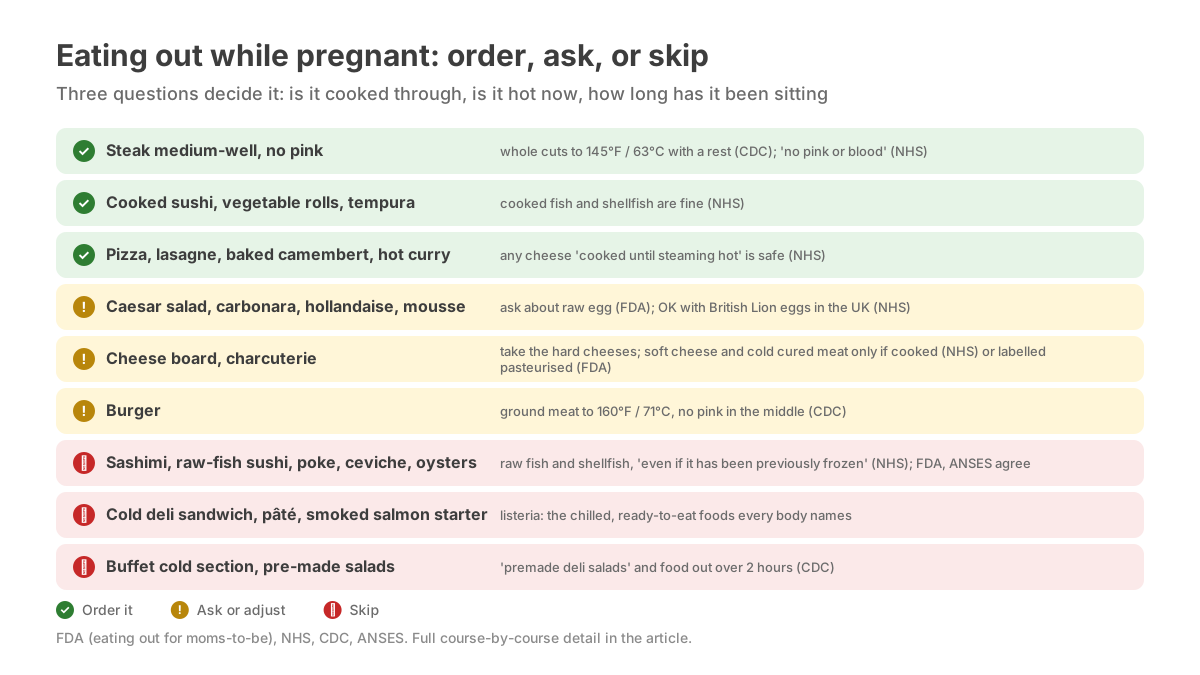
Order, ask, or skip: the three questions applied to a typical menu, from FDA, NHS, CDC and ANSES guidance.
What should I ask for when ordering while pregnant?
The FDA's advice for pregnant diners fits on a napkin:
- "Please always request that your food be cooked thoroughly, especially meat, poultry, fish, and eggs."
- "If it's lukewarm, send it back."
- "Request that raw sprouts not be added to your food."
- "Avoid foods that might contain raw or undercooked eggs," including Caesar dressing, custards and some sauces; "if you're unsure about a dish's ingredients, ask your server before ordering."
- Avoid "fresh-squeezed juice that may not be pasteurized."
Germany's recommendations add the principle behind it: in restaurants and cafeterias, pregnant women "should where possible consume food that has been heated immediately prior to consumption." Heat is the universal fix; the NHS says any food "cooked until steaming hot" is safe, including the cheeses and meats that are otherwise on the avoid list.
Starters: what is safe and what to skip
| Order | Verdict | Why |
|---|---|---|
| Soup, hot dips, baked camembert, halloumi, bruschetta, cooked prawns served hot | Safe | Cooked and hot |
| Charcuterie, prosciutto, salami, chorizo served cold | Skip, or ask for it cooked | Listeria; the NHS says cold cured meats "should be cooked until steaming hot" |
| Pâté, including vegetable pâté | Skip | Listeria (NHS, CDC) |
| Brie, camembert, goat's cheese with rind, blue cheese served cold | Skip | Listeria unless cooked (NHS); US diners may ask whether it is pasteurised (FDA) |
| Oysters, raw clams, ceviche, crudo | Skip | Raw shellfish and raw fish (NHS, ANSES, CDC) |
| Smoked salmon, gravlax | Skip unless in a hot cooked dish | Cold-smoked fish must be "cooked until steaming hot" (NHS) |
| Caesar salad with traditional dressing | Ask about the egg | Raw egg (FDA); OK with Lion eggs in the UK |
| Salads with raw sprouts | Ask for no sprouts | "Raw or lightly cooked sprouts" (CDC) |
Hard cheese and pasteurised fresh cheese such as mozzarella are fine cold; see cheese in pregnancy for the full list.
Mains: steak, burgers, chicken, fish and pasta
- Steak and lamb: order it cooked through. The NHS says to avoid "raw or undercooked meat," and the CDC's toxoplasma guidance sets 145°F (63°C) with a three-minute rest for whole cuts, which rules out rare and blue. Medium-well is the usual compromise; the FDA says to send it back if it arrives underdone.
- Burgers and minced meat: ground meat to 160°F (71°C) (CDC), so no pink in the middle. Most chains cook this way; independents may not.
- Chicken, duck, turkey: 165°F (74°C) (CDC); the NHS says poultry should have "no pink or blood." Pink duck breast is a no.
- Fish: cooked fish is encouraged, up to the limits in our foods to avoid during pregnancy guide. Skip swordfish, shark and marlin (NHS, FDA), seared tuna with a raw centre, and any dish built on smoked or raw fish. Low-mercury choices such as salmon, cod, haddock and sardines are good orders.
- Eggs: cooked until the white and yolk are firm, unless you are in the UK and the restaurant uses British Lion eggs, which the NHS allows runny.
- Pasta and risotto: fine; carbonara is the one to ask about, since it is finished with raw egg off the heat.
- Rolled or stuffed joints: the NHS singles out "rolled joints of meat – must be thoroughly cooked all the way through."
For the per-dish questions, our guides on deli meat, prosciutto, shrimp and crab go further.
Sushi, poke and Japanese menus
Sushi restaurants are easy once you split the menu into cooked and raw.
Order: vegetable rolls, cooked prawn (ebi) and tempura rolls, cooked eel (unagi), crab stick, teriyaki, katsu, gyoza, miso soup, edamame, cooked-fish nigiri.
Skip: anything with raw fish, including salmon, tuna, yellowtail and sea bass sashimi or nigiri, poke bowls with raw fish, and smoked-salmon rolls. The NHS is specific that freezing does not change this: avoid "sushi made with raw fish (even if it has been previously frozen) or raw shellfish." The FDA tells pregnant diners to skip "raw or undercooked fish, shellfish, and sushi or sashimi," and ANSES lists "sushi, sashimi, taramasalata" among foods to avoid.
Our sushi in pregnancy guide has the roll-by-roll list.
Buffets, salad bars and street food
Buffets concentrate the two things listeria likes: cold ready-to-eat food and time. The CDC's rule for perishable food is two hours at room temperature, or one hour above 90°F (32°C), and a buffet cannot tell you where it is in that window.
- Take: anything from the hot section that is steaming, hard cheeses, bread, whole fruit, cooked-to-order stations.
- Leave: cold meats, soft cheeses, pre-made salads (the CDC names "premade deli salads, such as coleslaw and potato, tuna, or chicken salad"), cut melon that has been out, smoked fish, cold prawns, raw sprouts, and desserts made with raw egg.
- Street food: the same test, applied harder; hot and cooked in front of you is the safest order on any street.
Takeaway, delivery and leftovers
The FDA's rules for pregnant customers:
- Take-out: eat hot food promptly; cold food within 2 hours of preparation.
- Delivery: eat within 2 hours of arrival, or keep it hot in an oven.
- Doggy bags: "If you won't be arriving home within 2 hours of being served, don't take the leftovers home with you."
- The 2-hour rule: discard perishables left at room temperature for more than 2 hours.
ANSES adds the home end: fridge at 4°C, leftovers "for no more than three days," reheated "to an internal temperature above +70°C."
The safest takeaways are the hot ones: curry, stir-fries, pizza, cooked noodle dishes, hot sandwiches. The ones to think about are cold: a cold deli sub with cured meat or soft cheese, a poke bowl, a sushi platter, a pre-made salad with grated cheese (ANSES avoids "cheeses sold grated").
Drinks and dessert
- Caffeine: 200 mg a day across the NHS, EFSA and ACOG, so one large coffee or two espressos; our caffeine guide has the counts.
- Alcohol: "no known safe amount" (CDC); "safest to avoid" (NHS). Ask about cooking with alcohol only for dishes that are not cooked after it is added.
- Juice and smoothies: pasteurised is fine; avoid fresh-squeezed juice that may not be (FDA).
- Desserts: mousse, tiramisu, homemade ice cream and meringue can contain raw egg; cheesecake and baked desserts are fine. Soft-serve ice cream is a listeria question of machine hygiene rather than ingredients; it is not on the NHS or FDA avoid lists, but a reputable outlet matters.
How Avo Pregnancy helps at the table
The menu questions above are the same every time, which is what makes them a good job for an app. Avo Pregnancy scans a menu photo or a plate and marks each dish safe, caution or avoid, with the guidance behind it, so "is the carbonara cooked?" becomes a question you ask the server with the answer already half known. It also keeps the 200 mg caffeine count running through the day.
When to call a doctor after eating out
If you realise afterwards that you ate something on the avoid list, the chance of illness is small; note it and watch for two weeks for a fever, aches, chills, nausea, diarrhoea, stomach ache or reduced baby movement, and call your midwife, GP or obstetrician if any appear. Our listeria in pregnancy and I ate something I shouldn't have guides cover what happens next.
Frequently asked questions
Can I eat at a sushi restaurant while pregnant?
Yes, with the right order. Cooked sushi (prawn tempura, cooked eel, crab stick, teriyaki chicken), vegetable rolls and cooked-fish dishes are fine. The NHS says to avoid 'sushi made with raw fish (even if it has been previously frozen) or raw shellfish', and the FDA tells pregnant diners to skip raw fish, sushi and sashimi. Check that the tuna or salmon is cooked, not seared.
Can I eat steak while pregnant?
Cooked through. The NHS says 'raw or undercooked meat' is to be avoided because of toxoplasmosis, and the CDC's safe temperature for whole cuts is 145°F (63°C) with a 3-minute rest, which is medium at the rarest. Ask for medium-well or well done with no pink, and send it back if it arrives rare; the FDA says to do exactly that.
Are buffets safe during pregnancy?
Hot buffets are safer than cold ones. Food kept steaming hot is fine; the risk is in cold, pre-made items such as deli meats, soft cheese, pre-made salads and cut fruit that have sat out. The CDC's rule is that perishable food left at room temperature for more than 2 hours should not be eaten, and buffets rarely tell you how long a dish has been there.
What salad dressings and sauces should I avoid when pregnant?
Those made with raw egg: traditional Caesar dressing, homemade mayonnaise, hollandaise and béarnaise, and desserts such as tiramisu and mousse. The FDA tells pregnant diners that some restaurants use uncooked eggs in Caesar dressing, custards and certain sauces and to 'avoid foods that might contain raw or undercooked eggs'. In the UK, dressings made with British Lion eggs are an exception under NHS guidance.
Is takeaway safe in pregnancy?
Hot takeaway eaten promptly is as safe as restaurant food. The FDA's rules are to eat hot food promptly, cold food within 2 hours of preparation, and delivered food within 2 hours of arrival. The risky orders are the cold ones: a cold deli sandwich with soft cheese or cured meat, or a poke bowl with raw fish.
Sources
The guidance in this article comes from these bodies. The badge shows which region's rules each one sets.
- USFDA — Food Safety for Moms-to-Be: Eating Out and Bringing In
- USFDA — Food Safety for Moms-to-Be: At a Glance
- USCDC — Preventing Listeria Infection
- USCDC — Preventing Toxoplasmosis
- USCDC — About Alcohol Use During Pregnancy
- UKNHS — Foods to avoid in pregnancy
- UKNHS — Is it safe to eat sushi during pregnancy?
- UKNHS — Listeriosis
- EUANSES — Listeriosis and how you can prevent it
- EUEFSA — Caffeine: scientific opinion summary (2015)
- EUGermany, Healthy Start – Young Family Network — Diet and lifestyle before and during pregnancy (2018)