Baby Poop After Starting Solids: Colours, Constipation and Undigested Food (What's Normal)
Firmer, darker, smellier poo with bits of food in it is normal after solids. What the AAP, NHS and ESPGHAN say about colours, constipation and when to call a doctor.
By the Avo Parenting teamPublished October 20, 20269 min read
In short
- Expect firmer, darker, smellier poo once solids start; the AAP says solids 'add new shades and substance to the mix'.
- Orange after carrots, green after spinach or peas, and visible bits of food are normal; red, black (after the newborn weeks) and white or pale poo need a doctor (AAP).
- Constipation means fewer than 3 poos a week, large hard poo or 'rabbit droppings', or straining and pain (NHS); straining and going red on its own is not constipation (AAP).
- For a constipated baby on solids, the AAP suggests fruit and vegetables, especially prunes; the NHS says extra sips of water and plenty of fruit and veg, and to see a GP early.
- Diarrhoea is usually a virus, not a food; the NHS says call 111 for any worry about a baby under 12 months, bloody poo, or diarrhoea lasting more than 7 days.
Poo changes the week solids start, and almost every change is normal. It gets firmer because there is now something to form; darker and smellier because there is more to digest; and it comes out with recognisable pieces of what went in because a baby's gut is quick and their chewing is not.
That still leaves parents at the changing mat wondering whether a particular nappy is fine. This guide goes through what the American Academy of Pediatrics (AAP), the UK's NHS and the European and North American paediatric gastroenterology societies (ESPGHAN and NASPGHAN) say about colour, consistency, constipation and diarrhoea after starting solids, and the short list of things that need a doctor.
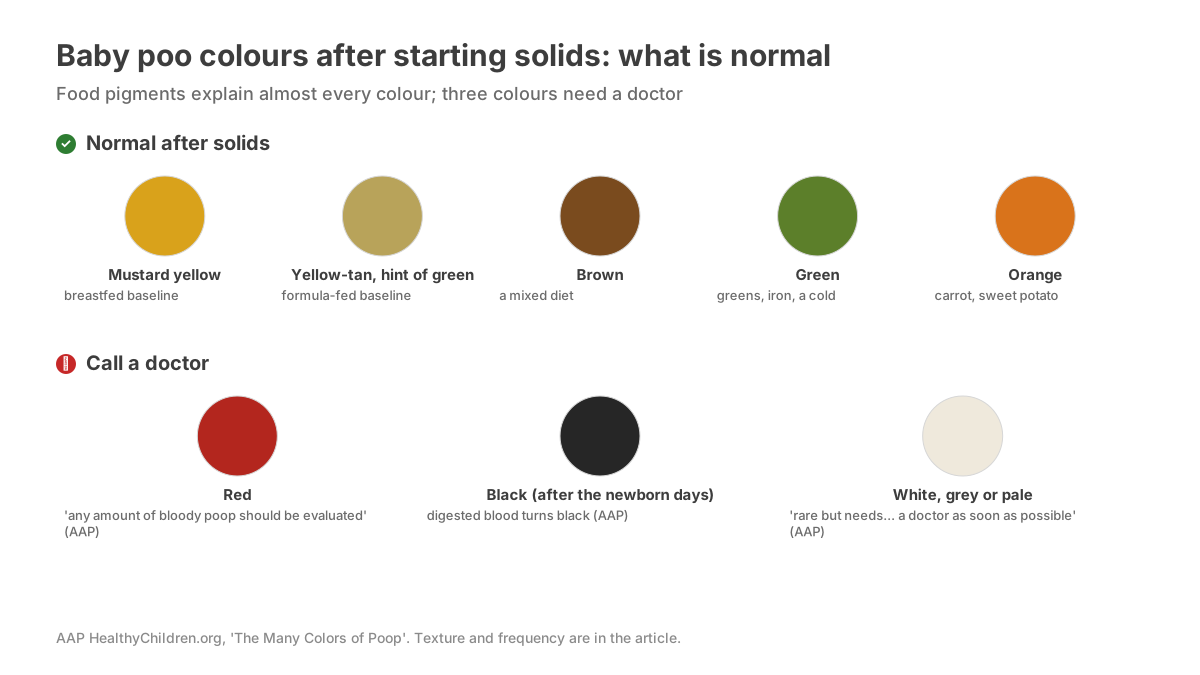
Poo colours after starting solids, following the AAP's 'The Many Colors of Poop'.
What does normal baby poop look like after starting solids?
Before solids, the AAP's baseline is "mustardy yellow" for breastfed babies and "yellow-tan with hints of green" for formula-fed ones, soft and often loose. From 6 months, the AAP says solids and colds "add new shades and substance to the mix." In practice that means:
- Firmer. Poo thickens towards a paste and, over the following months, towards toddler-style formed stools. It should still be soft.
- Darker and browner. Brown is the colour of a mixed diet. It usually arrives within a week or two of starting solids.
- Smellier. Breastfed-baby poo smells mild; solids end that. The smell on its own tells you nothing about health.
- With bits in it. Pea skins, corn, blueberry skins, raisins and shreds of carrot or spinach can pass through almost intact. This is a chewing and transit-time issue, not a digestion problem.
- Less frequent, or more. Both happen while the gut adjusts. The AAP says formula-fed babies "usually have a bowel movement most days" but "a gap of 1 to 2 days can be normal," and that breastfed babies "may go several days or even a week between bowel movements."
If you are logging foods, this is the stage where logging nappies next to them earns its keep: a pattern (firmer after rice cereal, looser after pear) is easy to see on a timeline and impossible to remember.
Which poop colours are normal and which need a doctor?
Most colour comes from food, and the AAP's position is that the shades of brown, green, orange and yellow are all fine. Three colours are different.
| Colour | What it usually means | What the AAP says |
|---|---|---|
| Brown, tan, mustard | A normal mixed diet | The colour of choice once solids are established |
| Green | Green vegetables, iron-fortified cereal or formula, a cold, faster transit | Normal; expected in formula-fed babies as "hints of green" |
| Orange | Carrot, sweet potato, pumpkin, apricot | Normal; food pigments pass through |
| Red | Beetroot, tomato, red berries, or blood | "Seeing red can mean blood"; "any amount of bloody poop should be evaluated" |
| Black | Meconium in the first days; later, digested blood or iron supplements | Black poo after the first few meconium stools "is worth attention" because blood "typically turns black as it moves through the intestines" |
| White, pale, chalky | Possible lack of bile from the liver | "Quite rare but needs to be brought to the attention of a doctor as soon as possible" |
The test for red is simple: if you fed beetroot yesterday, that is probably the answer, and if you did not, call your doctor the same day. The NHS gives the same instruction for red, black and very pale poo through its constipation and feeding pages: get it checked.
Is my baby constipated after starting solids?
The NHS definition, from its constipation page, is that a child may be constipated if:
- "they have done less than 3 poos in the last week"
- "their poo is large and hard"
- "their poo looks like 'rabbit droppings' or little pellets"
- "they are straining or in pain when they poo"
- "they have a poor appetite or stomach pain that improves after they poo"
The frequency on its own is not enough. The AAP's point is that effort is normal: "straining at the stool isn't necessarily alarming," even when the baby cries or goes red, because pooing takes real work for an infant lying on their back.
Its warning signs are different: excessive fussiness, more spitting up than usual, a sharp change in how often the baby poos, hard stools or blood with hard stools, and straining "for more than 10 minutes without success."
Why solids cause it: the first foods many families use, rice cereal, banana and plenty of cheese, are low in fibre and fluid, while the milk feeds that kept everything soft are shrinking. Add a baby who is not yet drinking much water and the result is a harder stool within a couple of weeks of starting.
ESPGHAN and NASPGHAN, in their joint guideline on functional constipation, built a separate algorithm for infants under 6 months and another for older infants and children, which is a reminder that constipation in a 7 month old is common enough to have its own clinical pathway and usually has no underlying disease. The guideline is written for clinicians rather than parents; its practical message, echoed by the NHS, is that constipation is easier to treat early than late.
What helps a constipated baby?
Diet first, and in a specific order.
- Fruit and vegetables. The AAP's advice for babies on solids is "vegetables and fruits, especially prunes." Prunes, pear, peach and plum contain sorbitol, which draws water into the gut. The NHS asks for a varied diet with "plenty of fruit and vegetables" for fibre.
- Water. Once solids have started, the NHS says to offer sips of water from an open cup at meals; for a constipated formula-fed baby not yet on solids it allows "extra drinks of water between their formula feeds," cooled boiled water under 6 months.
- Swap the binders. Rice cereal is a common culprit; the CDC in any case recommends a variety of fortified cereals (oat, barley, multigrain) rather than rice alone. Our iron-rich first foods guide has the alternatives.
- Keep the milk. The NHS says breastfed babies should get "plenty of breastfeeds." Do not dilute formula.
- Movement. Bicycling the legs and tummy time are harmless and often help; no body objects to them, though none has evidence to cite either.
What not to do: the AAP says fruit juice "is not recommended" for babies under one year, although its constipation page allows a small amount of apple or pear juice as a specific remedy from one month old. The NHS says laxatives "are often recommended for children who are eating solid foods, alongside diet and lifestyle changes," but that is a decision for a GP, not a pharmacy shelf.
And see the doctor early: the NHS's line is that "the longer your child is constipated, the more difficult it can be for them to get back to normal."
Avo Starting Solids logs every nappy, with form, colour and type, on the same timeline as every food, so when the GP asks "how many days, and what changed?" you can show them rather than guess. Many foods in the library carry a poop-friendly flag for exactly this situation.
What if my baby has diarrhoea after a new food?
A loose nappy after a new food is common and usually meaningless; the gut has met something new. Diarrhoea is different: the AAP defines it as "loose, watery and more frequent bowel movements," and says "most diarrhea in children is caused by viruses," with "changes in diet" and "allergy to foods" as other causes.
The things that make a loose nappy worth a call:
- it keeps coming back with the same food
- it arrives with hives, facial swelling or vomiting within two hours of eating, which points to an allergic reaction (call emergency services for breathing difficulty or floppiness)
- it lasts: the NHS says to call 111 for diarrhoea "for more than 7 days" at any age, and for any worry at all "about a baby under 12 months"
- there is blood in it, or the vomit is green
Keep feeding through it. The NHS says to "carry on breast or bottle feeding your baby," to give "small sips of water between feeds" to babies on formula or solids, and never to "make baby formula weaker." The AAP agrees that mild diarrhoea without vomiting needs no change of diet, and that juice, soft drinks and sports drinks make it worse. Dehydration is the thing to watch: the NHS's marker for under-5s is "fewer wet nappies."
If the food in question is a common allergen, our allergens 101 guide explains how to reintroduce it safely and what a true reaction looks like.
Where US, UK and European guidance differs
Poo is one of the few feeding topics where the bodies barely disagree; the differences are in what they bother to write down.
| Question | US (AAP, CDC) | UK (NHS) | Europe (ESPGHAN/NASPGHAN) |
|---|---|---|---|
| Definition of constipation | Hard stools, blood with hard stools, straining over 10 minutes without result; a 1–2 day gap is normal | Fewer than 3 poos a week, large hard poo or pellets, straining or pain | Rome criteria, with separate algorithms for under and over 6 months |
| First remedy on solids | Fruit and vegetables, especially prunes; small amounts of apple or pear juice from 1 month as a remedy | Fruit and vegetables, sips of water; laxatives only via a GP | Early medical review; treatment decided by the clinician |
| Juice | Not recommended under 12 months, except as a constipation remedy | Not recommended; water or milk only | Not addressed in the constipation guideline |
| When to seek help | Dietary changes do not help; any blood; white poo | Any suspected constipation ("get help early"); any worry about a baby under 12 months with diarrhoea | Early, before the problem becomes chronic |
The practical difference is the juice remedy, which only the AAP offers, and only in small, age-scaled amounts. UK parents are steered to water, fruit and the GP.
When should I call a doctor about my baby's poop?
Same day:
- any red that cannot be explained by yesterday's beetroot or berries, or any visible blood
- black poo after the newborn weeks (unless your baby is on an iron supplement, and even then mention it)
- white, grey or pale clay-coloured poo
- a hard, painful stool with blood, or straining for more than 10 minutes with nothing to show
- diarrhoea with fewer wet nappies, a dry mouth, or a baby who is unusually sleepy
Within a few days:
- fewer than 3 poos in a week together with hard poo or discomfort, especially if it began with solids
- diarrhoea that has lasted more than 7 days, or that returns with a particular food
For everything else, the nappy after a plate of carrot and peas is a record of a meal, not a problem. Keep the foods and the nappies in the same log, keep offering fruit, vegetables and water, and the pattern will usually sort itself out within a few weeks of the start of solids.
Frequently asked questions
Why is there undigested food in my baby's poop?
Because a 6 to 12 month old chews little and the gut moves food through quickly, so pea skins, corn, raisins and bits of carrot often come out looking much as they went in. The AAP notes that starting solids adds 'new shades and substance' to poo. It is normal as long as your baby is growing, comfortable and the poo is otherwise soft.
What colours of baby poop are not normal?
Three. The AAP says any red can mean blood and 'any amount of bloody poop should be evaluated'; black poo after the first few meconium days deserves attention because digested blood turns black; and white poo 'is quite rare but needs to be brought to the attention of a doctor as soon as possible' because it can signal a liver problem. Green, orange and brown are all fine.
Is it normal for a baby to go several days without pooping after starting solids?
It can be. The AAP says formula-fed babies usually go most days but a gap of 1 to 2 days can be normal, and breastfed babies may go several days or even a week. The NHS counts fewer than 3 poos a week as a sign of constipation only when it comes with hard poo, straining or pain. Soft poo after a gap is not constipation.
What foods help a constipated baby?
The AAP points to fruit and vegetables, especially prunes, once a baby is on solids; pear, peach and plum work in the same way. The NHS advises plenty of fruit and vegetables for fibre, extra sips of water for babies on solids, and seeing a GP early rather than waiting, because the longer constipation lasts the harder it is to fix.
Can a new food cause diarrhoea?
Occasionally, and a one-off loose nappy after a new food is not a reaction. The AAP says most diarrhoea in children is caused by viruses and lists changes in diet and food allergy as other causes. Diarrhoea that comes with a rash, swelling or vomiting soon after a food, or that keeps returning with the same food, is worth a call to your doctor and a note in your food log.
Sources
The guidance in this article comes from these bodies. The badge shows which region's rules each one sets.
- USAAP HealthyChildren.org — The Many Colors of Poop
- USAAP HealthyChildren.org — Infant Constipation
- USAAP HealthyChildren.org — Diarrhea in Children: What Parents Need to Know
- USCDC — When, What, and How to Introduce Solid Foods
- UKNHS — Constipation in children
- UKNHS — Diarrhoea and vomiting
- UKNHS Best Start in Life — What to feed your baby from around 6 months
- EUESPGHAN / NASPGHAN — Evaluation and treatment of functional constipation in infants and children (2014)